




Resource > Blogs >
Drug interaction pharmacokinetics: Measuring changes in exposure
Filed under: ADME, Drug absorption, Drug bioavailability, Drug metabolism, and General OOC

With polypharmacy common in several patient populations, assessment of drug-drug interaction (DDI) is a routine part of DMPK workflows. Interactions alter exposure through enzyme inhibition, enzyme induction, or effects on drug transporters; however, identifying the mechanism is only part of the assessment. Development decisions depend on understanding drug interaction pharmacokinetics, particularly how far an interaction changes the exposure of the compound that matters.
Certain interactions are engineered deliberately. Pharmacokinetic boosting uses one compound to inhibit the metabolism of another, thereby raising its exposure to support effective dosing. The same inhibition can pose unintended risks to other medicines a patient is taking. DDI assessment must distinguish these cases and size each one early enough to act on.
Measuring drug interaction pharmacokinetics across the gut-liver axis
Conventional in vitro assays establish whether a compound is a substrate, inhibitor, or inducer of a given enzyme or transporter. Physiologically based pharmacokinetic (PBPK) models then extrapolate these mechanistic inputs to populations, doses, and clinical scenarios. Both are essential, but neither measures the combined effect of intestinal and hepatic processes on a single oral dose.
That effect depends on several sequential processes: absorption across the intestinal barrier, intestinal metabolism and efflux, and hepatic metabolism. What reaches the liver depends on what the intestine has already absorbed, metabolized, or returned to the lumen. When each process is defined in a separate assay, modeling must reconstruct the overall effect of exposure rather than measure it.
Measuring exposure across the gut-liver axis
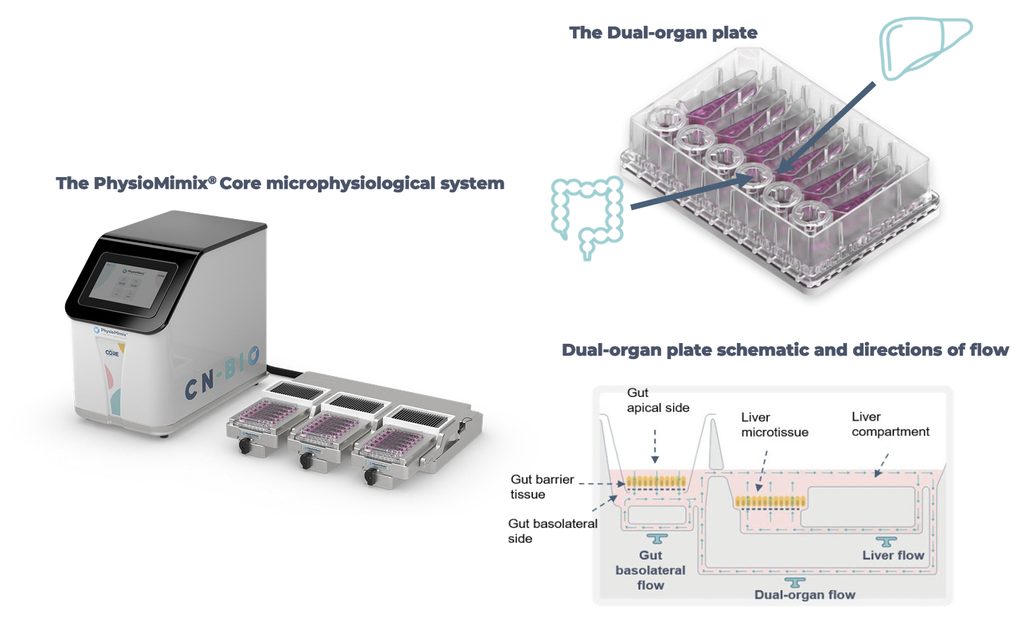
CN Bio’s Gut/Liver-on-a-chip is designed to study drug interaction pharmacokinetics by measuring the combined effect of intestinal and hepatic processes on exposure. On the PhysioMimix® Core system, primary human jejunum tissue (RepliGut® Planar) in an upstream gut compartment is fluidically connected under perfusion to primary human hepatocyte microtissues in a downstream liver compartment. A compound dosed onto the intestinal surface is absorbed and processed in the gut before reaching the liver, as in an oral dose.
Dosing the same compound directly into the liver compartment represents the intravenous route. Comparing the two concentration profiles yields the oral bioavailability in human tissue, and mechanistic modeling then estimates the three fractions whose product equals that value: the fraction absorbed and the fractions escaping gut and hepatic metabolism.1 The result shows how much exposure changes when a second compound is added, and where along the gut-liver axis that change arises. Three studies, each covering a different mechanism, show what this adds.
Inhibition: pharmacokinetic boosting
Darunavir has low oral bioavailability when taken alone, because CYP3A metabolizes much of each dose before it reaches systemic circulation. Co-administration with ritonavir, a potent CYP3A inhibitor, substantially increases that exposure, which is why darunavir is given as a boosted regimen.2
In the Gut/Liver-on-a-chip, ritonavir suppressed CYP3A4 activity, and darunavir’s oral bioavailability increased with co-administration, consistent with clinical observations. Mechanistic modeling showed intrinsic clearance falling in both compartments, with the liver accounting for the larger share. Identifying CYP3A inhibition flags the interaction, while measuring its effect on bioavailability indicates whether it is large enough to shape a regimen. CYP3A inhibition is not selective, however. Ritonavir’s effect on other CYP3A substrates a patient takes can be unintended and harmful, which is why boosted regimens carry a well-documented risk of interactions in polypharmacy.
Induction: the opposite challenge
Induction runs in the reverse direction. An inducer increases available enzyme, accelerates clearance, and lowers exposure to the victim compound. For a compound cleared by the induced enzyme, the risk is loss of efficacy, which often produces no signal until treatment stops working.
In the Gut/Liver-on-a-chip, pre-dosing with rifampicin, a strong CYP3A4 inducer, increased CYP3A4 activity in the liver compartment. Dabrafenib, a BRAF kinase inhibitor and CYP3A4 substrate, was then metabolized faster and its oral bioavailability fell. Sampling over 72 hours of continuous perfusion also showed that dabrafenib’s metabolic rate increased over time, consistent with the auto-induction observed in patients, in which apparent clearance increases with repeat dosing.3 A clearance value measured once can therefore misrepresent steady-state exposure in an optimistic direction, so compounds that induce their own metabolism, or will be given alongside an inducer, need exposure characterized over a time course.
Transport and prodrug activation
Not every clinically important interaction runs through a metabolizing enzyme. Efflux transporters such as P-glycoprotein (P-gp) return absorbed compounds to the intestinal lumen, so inhibiting them can increase exposure without altering metabolic clearance. P-glycoprotein inhibition can therefore increase exposure without altering metabolic clearance.
Dabigatran etexilate, the oral prodrug of the anticoagulant dabigatran, is a recognized probe substrate for intestinal P-gp. Carboxylesterases activate it through two hydrolysis steps, with CES2 predominating in the intestine and CES1 in the liver. Caco-2 cells, the standard permeability model, do not reproduce this intestinal esterase profile, whereas the primary human jejunum in the Gut/Liver-on-a-chip does. Here, intermediate metabolites formed on the gut side, and the liver compartment released active dabigatran, corresponding to the human activation sequence.
Adding zosuquidar, a selective P-gp inhibitor, caused only a small change in parent prodrug absorption but a larger increase in active dabigatran exposure. Measuring the parent alone would have understated the interaction, because the anticoagulant effect depends on a molecule formed after absorption. Assessing drug interaction pharmacokinetics therefore requires tracking exposure to the active drug, not just the administered prodrug.
See the dataset behind the model
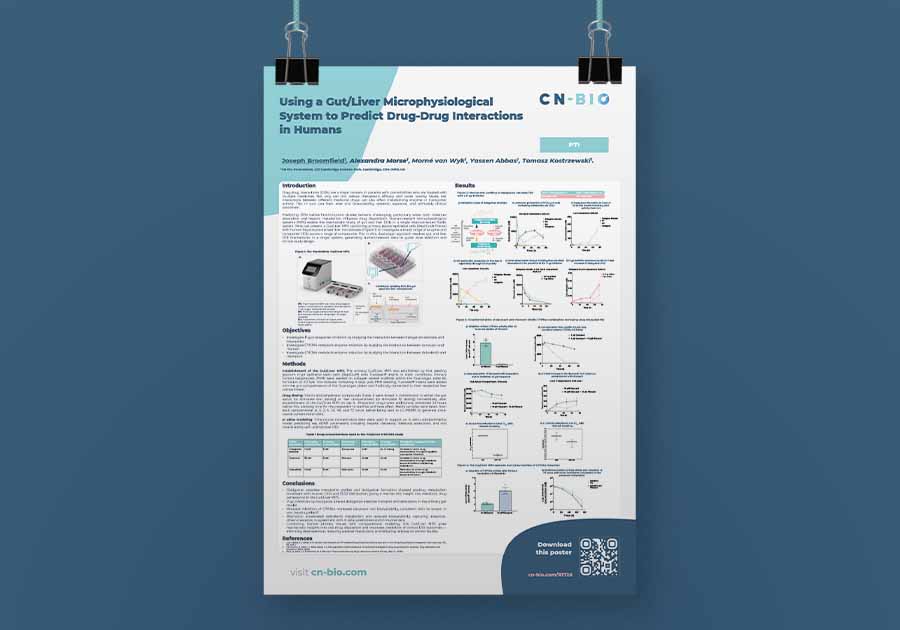
The poster sets out the transporter and enzyme interaction data in full, including how P-gp inhibition, CYP3A4 inhibition, and CYP3A4 induction changed drug absorption, metabolism, and bioavailability in the Gut/Liver MPS.
Although a three-donor study cannot characterize population-level variability, it can establish whether the assay resolves donor-specific differences. What they demonstrate is analytical resolution: the assay can distinguish individuals within the same experimental system, using the same tissue architecture, the same flow conditions, and the same analytical method. That is the property being tested, and it is a prerequisite for the larger donor panels that would follow.
Adding to the DDI framework toolkit
None of this replaces established DDI methods. Each has its place in the workflow:
- Mechanistic enzyme and transporter assays identify and characterize the liability.
- The Gut/Liver-on-a-chip measures its effect on exposure across connected human tissues.
- PBPK modeling extrapolates the results to populations, dose regimens, and scenarios no assay can run.
Gut/Liver-on-a-chip data still require scaling, since tissue mass, perfusion rate, and protein binding differ from those in a patient. Extrapolation then starts from one measurement in which the gut and liver processes have already acted on one another, rather than from several generated independently.
From interaction flag to development decision
For development teams, measuring an interaction’s effect on exposure before the clinic informs practical decisions: whether boosting increases exposure sufficiently for the intended regimen, whether an induction liability is manageable, whether time-dependent metabolism affects dose selection, and which clinical DDI studies to prioritize. As programs lessen reliance on animal studies, human tissue data of this kind strengthens the non-clinical evidence package.
Measure the effect, then decide
Across three mechanisms, one system measured the same outcome: the change in exposure of the compound that matters. Enzyme inhibition increased it, enzyme induction decreased it, and transporter inhibition altered the extent to which an oral dose was absorbed and activated. By connecting absorption, intestinal metabolism, and hepatic metabolism in human tissue, the Gut/Liver-on-a-chip turns an interaction flag into a measurement that dose selection, safety margins, and clinical study design can build on.
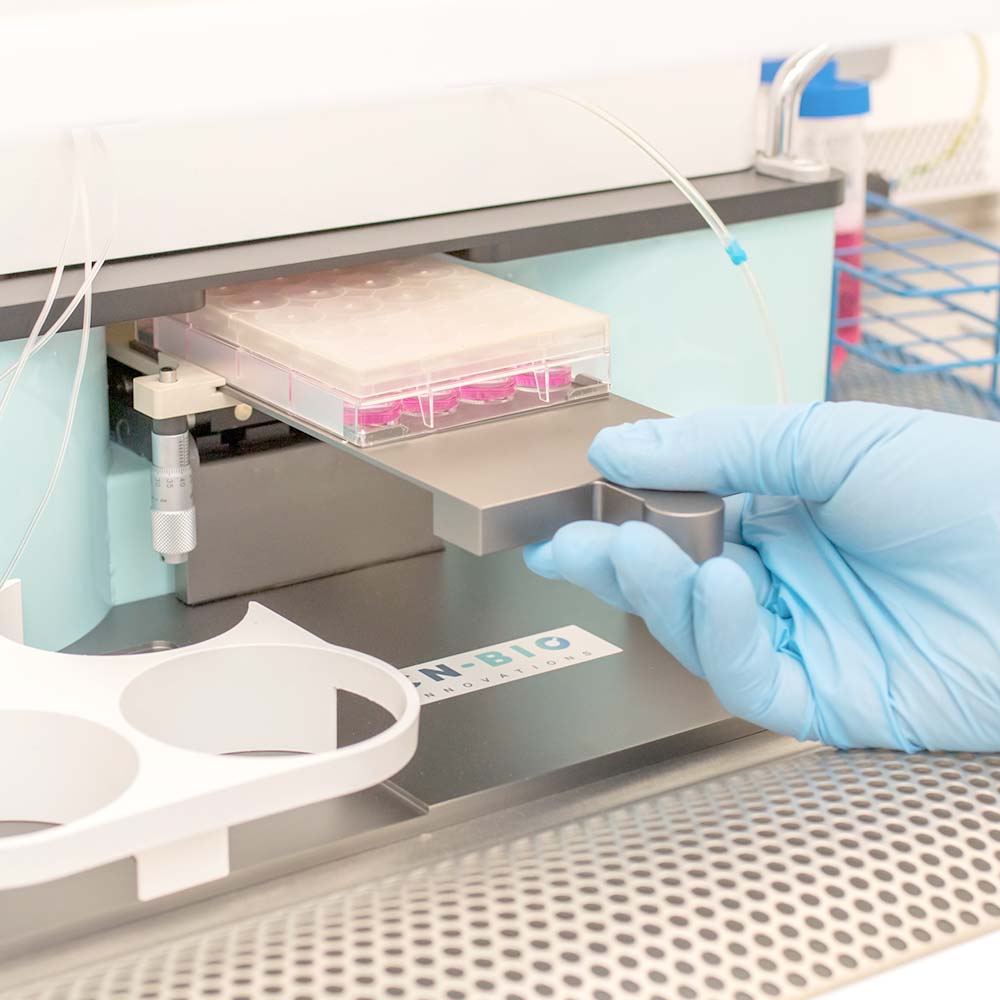
Bring exposure data into your DDI workflow. Run the assay through our ADME Contract Research Services, or bring it in-house with the PhysioMimix Core and Gut/Liver-on-a-chip. Talk to our ADME team about your compound.
References
1. Abbas Y, et al. A primary human Gut/Liver microphysiological system to estimate human oral bioavailability. Drug Metab Dispos. 2025;53(9):100130.
2. Darunavir tablets, US prescribing information. Clinical pharmacology.
3. Puszkiel A, et al. Clinical pharmacokinetics and pharmacodynamics of dabrafenib. Clin Pharmacokinet. 2019;58(4):451-467.