


Resource > Scientific publications >
A primary human Gut/Liver MPS to estimate human oral bioavailability
Filed under: ADME and Drug bioavailability
Summary
Researchers at CN Bio Innovations and Altis Biosystems used the PhysioMimix® platform with the Dual-organ plate to build a Gut/Liver MPS made entirely from primary human cells, then paired it with mechanistic mathematical modeling to estimate the human oral bioavailability of midazolam and its separate gut and liver components. The primary Gut/Liver MPS predicted an human oral bioavailability of 0.47 for midazolam, within the range reported in humans, and unlike the Caco-2 comparator it showed functional gut wall metabolism through CYP3A4 activity. The result gives drug developers a single in vitro platform that separates the gut and liver contributions to first-pass metabolism, a profile that standard assays measure in isolation.
Study facts at a glance
| Publication | Abbas Y, van Wyk M, Sze H, Christophi J, Spreen AA, Bliton RJ, Boazak EM, Kostrzewski T. A primary human Gut/Liver microphysiological system to estimate human oral bioavailability. Drug Metabolism and Disposition. 2025;53:100130 |
| DOI | 10.1016/j.dmd.2025.100130 |
| CN Bio product used | PhysioMimix® System used with the Multi-chip Liver-12 plate (MPS-LC12) and the Multi-chip Dual-organ Plate (MPS-TL6) |
| How the platform was used | The PhysioMimix System maintained a fluidically coupled primary human gut barrier tissue and 3D liver microtissue in the Multi-chip Dual-organ Plate under recirculating flow (0.5 μL/s in the gut basolateral compartment, 1.0 μL/s in the liver compartment), supporting a PK dosing and sampling window of up to 72 hours. |
| Biological context | An in vitro MPS, also called organ-on-a-chip, built entirely from primary human cells: a gut barrier tissue derived from human jejunum and a liver microtissue derived from primary human hepatocytes. The application is human oral bioavailability and first-pass metabolism estimation for drug discovery, using healthy tissue rather than a disease model. |
| Comparator | A Caco-2/Liver MPS, where the gut compartment used the Caco-2 immortalized human colorectal adenocarcinoma cell line (the conventional cell line for oral absorption studies), alongside published human in vivo bioavailability data for midazolam. |
| Key readouts | Transepithelial electrical resistance, albumin production, urea production, CYP3A4 activity, LDH, phase I and phase II metabolic gene expression, histology, and concentration-time profiles measured by ultra-high performance liquid chromatography-tandem mass spectrometry, used to estimate the fraction absorbed (Fa), the fraction escaping gut wall elimination (Fg), the fraction escaping hepatic elimination (Fh), and human oral bioavailability (F). |
| Main interpretation |
Table of Contents
- Summary
- Study facts at a glance
- Which CN Bio product was used?
- What this paper is about
- What the researchers found
- Why the paper matters
- Key study takeaways
- Why this paper is worth reading
- FAQs
- Full citation
Which CN Bio product was used?
The study used the PhysioMimix platform. Liver-only experiments ran on Multi-chip Liver-12 plate (MPS-LC12), with each well holding 1.6 mL of medium under a flow rate of 1.0 μL/s. The Gut/Liver MPS ran on the Multi-chip Dual-organ Plate (MPS-TL6), which has 6 wells, each split into a gut compartment and a liver compartment joined by a fluidic channel, with pneumatically driven micropumps recirculating the media and allowing independent flow control in each compartment (0.5 μL/s in the gut basolateral compartment, 1.0 μL/s in the liver compartment). Media kept both tissues functional in coculture for up to 72 hours: gut/liver apical medium (GAM) on the apical side of the gut, and gut/liver circulation medium (GCM) across the connected gut basolateral and liver compartments. The platform supplied the cultured tissues and the perfusion for the experiments, while the bioavailability estimates came from a separate mechanistic mathematical model fitted to the concentration data.
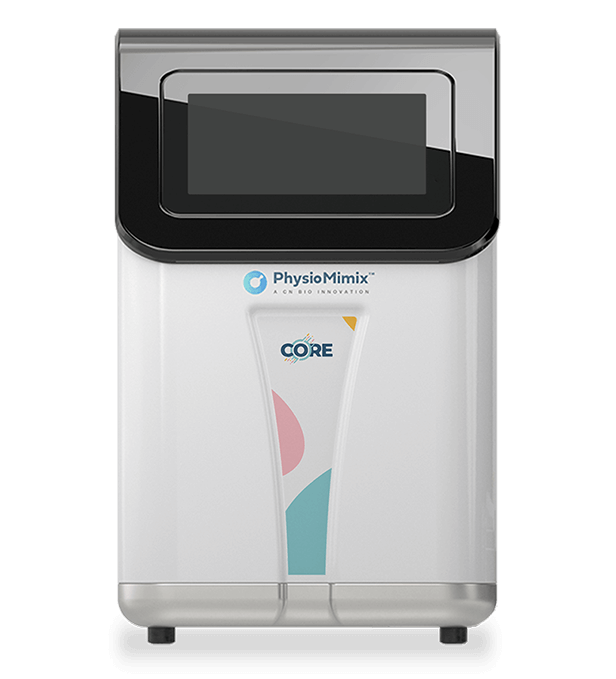
Find out more about the PhysioMimix Core system
What this paper is about
Human oral bioavailability is the fraction of an administered drug that reaches systemic circulation after absorption in the gut and first-pass metabolism in the gut wall and liver. It depends on the relationship between gut absorption, gut metabolism, and hepatic metabolism, and predicting it correctly is central to setting safe and effective oral doses. Standard in vitro tools measure these steps separately. Caco-2 cells are widely used to estimate the fraction absorbed but express low levels of key drug-metabolizing enzymes, including CYP3A4, so they report gut wall metabolism poorly. Liver microsomes and suspension hepatocytes capture hepatic clearance but lose enzyme activity over time. Animal models are weak quantitative predictors of human bioavailability, with one study of 184 compounds finding a correlation (R²) of about 0.34 between human and animal data.
This paper describes a dual-organ MPS that links a gut barrier tissue and a liver microtissue, both made from primary human cells, in one perfused system that can simulate oral and intravenous (IV) dosing. The gut barrier tissue was derived from human jejunum (RepliGut Planar Jejunum, Altis Biosystems), the intestinal region where most oral drugs are absorbed, and the liver microtissue was derived from primary human hepatocytes. The authors combined the platform with a mechanistic mathematical model and used midazolam, a CYP3A substrate subject to both gut and liver extraction, as a case study to estimate bioavailability and its components.
What the researchers found
The primary Gut/Liver MPS estimated an human oral bioavailability (F) of 0.47 for midazolam. Human data put midazolam bioavailability at a mean of around 0.31 to 0.33 across 36 studies, with a reported range of 0.096 to 0.68, so the model estimate sat within the observed human range. The Caco-2/Liver MPS gave a higher value of 0.65.
Breaking bioavailability into its parts, the primary Gut/Liver MPS gave a fraction absorbed (Fa) of 0.93 (0.98 for the Caco-2 model), matching the human in vivo value for midazolam of 0.93. The fraction escaping gut wall elimination (Fg) was 0.79 for the primary model and 1.0 for the Caco-2 model, meaning the primary gut tissue removed a measurable amount of drug through gut wall metabolism while Caco-2 removed none. The fraction escaping hepatic elimination (Fh) was 0.64 for the primary model and 0.66 for the Caco-2 model, both in line with human in vivo data.
The primary gut tissue showed functional CYP3A4 activity, confirmed by production of the metabolite 1′-hydroxymidazolam, whereas the Caco-2 gut tissue produced none. Estimated intrinsic gut clearance of midazolam was 2.34 μL/h for the primary tissue against 0.0340 μL/h for Caco-2. The primary gut tissue also formed a continuous mucus layer, stained by alcian blue, and showed higher expression of metabolic genes including CYP3A4, while Caco-2 formed no mucus layer. Before the midazolam case study, the authors validated the coculture with 7-hydroxycoumarin (7-HC), a compound cleared by glucuronidation, and showed that adding the liver microtissue lowered the compound’s exposure in the liver compartment. Among the candidate models, a 2-compartment model with nonlinear (Michaelis-Menten) liver clearance gave the best fit by the Akaike information criterion (AIC) and was used to derive the parameter estimates.
Why the paper matters
Drug developers need to know how much of an oral compound will reach the bloodstream, and whether any shortfall comes from poor absorption, gut wall metabolism, or liver clearance, because each problem calls for a different fix. Current in vitro assays measure these steps in separate systems, and the most common gut model, Caco-2, cannot report gut wall metabolism because it lacks CYP3A4 activity. This work puts gut absorption, gut metabolism, and hepatic metabolism in one perfused system built from primary human cells, then uses mechanistic modeling to extract organ-specific parameters and a bioavailability estimate.
For midazolam, the primary gut tissue captured the gut wall metabolism that Caco-2 missed, which is the contribution that earlier Gut/Liver systems using immortalized gut cell lines could not measure. Because the platform also runs IV dosing, it can separate gut and liver effects directly rather than relying on assumed scaling factors such as enterocyte number or intestinal surface area. The parameters it produces can feed physiologically based pharmacokinetic (PBPK) models to support first-in-human dose selection. The authors note that the US Food and Drug Administration recently cited this kind of combined MPS and in silico approach as a promising way to reduce animal testing in preclinical safety work, which matters for teams aligning their workflows with changing regulatory expectations.
Key study takeaways
- The study used the PhysioMimix Multi-organ System with the Dual-organ plate to coculture a primary human gut barrier tissue and a primary human liver microtissue in one fluidically connected system.
- The primary gut tissue showed functional CYP3A4 metabolism and formed a mucus layer, reproducing features of the human intestinal lining that the Caco-2 cell line does not provide.
- Compared with the Caco-2/Liver MPS, the primary Gut/Liver MPS detected gut wall metabolism of midazolam, with a fraction escaping gut wall elimination of 0.79 versus 1.0 for Caco-2 (where 1.0 means no measurable gut metabolism).
- The workflow combined functional readouts (TEER, albumin, urea, CYP3A4 activity, and LDH), concentration-time data by mass spectrometry, and mechanistic modeling to estimate the fraction absorbed, the fraction escaping the gut, and the fraction escaping the liver.
- The platform estimated a midazolam human oral bioavailability of 0.47, within the human range, supporting its use for profiling the first-pass metabolism of orally dosed compounds in drug discovery.
- The authors describe the model as most straightforward for high-permeability, high-solubility compounds (Biopharmaceutics Classification System [BCS] class I, such as midazolam) and call for validation across more compounds, enzymes, transporters, and cell donors.
Why this paper is worth reading
This paper is useful for absorption, distribution, metabolism, and excretion (ADME) scientists and pharmacokineticists who want to estimate human oral bioavailability in vitro and attribute it to specific organs. It lays out a working method: primary human Gut/Liver coculture on the PhysioMimix platform, periodic concentration sampling, and a fitted mechanistic model that returns Fa, Fg, Fh, and overall bioavailability for a CYP3A substrate. For anyone weighing whether a primary gut tissue adds enough over Caco-2 to justify the extra effort, the side-by-side comparison gives concrete numbers on gut wall metabolism, permeability, and predicted bioavailability, along with a clear statement of where the assay still needs validation.
FAQs
The study used the PhysioMimix Platform with the Multi-chip Liver-12 plate (MPS LC-12) for liver-only experiments and the Multi-chip Dual-organ Plate (MPS-TL6) for the Gut/Liver coculture.
How was the platform used?
The PhysioMimix Multi-organ System maintained a primary human gut barrier tissue and a primary human liver microtissue in fluidically connected compartments under recirculating flow, with media sampled over a window of up to 72 hours to track drug and metabolite concentrations for pharmacokinetic modeling.
The study built a primary human Gut/Liver microphysiological system, with the gut barrier tissue derived from human jejunum and the liver microtissue derived frm primary human hepatocytes. The application is oral bioavailability and first-pass metabolism estimation for drug discovery rather than a specific disease.
What was the main finding of the paper?
The primary Gut/Liver MPS, combined with mechanistic modeling, estimated a midazolam oral bioavailability of 0.47, within the range reported in humans, and it captured gut wall CYP3A4 metabolism that the Caco-2 comparator did not.
The study compared the primary Gut/Liver MPS against a Caco-2/Liver MPS, which used the Caco-2 cell line in the gut compartment, and against published human in vivo bioavailability data for midazolam.
The study used transepithelial electrical resistance (TEER), albumin and urea production, CYP3A4 activity, LDH, metabolic gene expression, histology, and concentration-time profiles of midazolam and 1′-hydroxymidazolam measured by ultra-high performance liquid chromatography-tandem mass spectrometry.
The paper gives ADME and pharmacokinetics teams highlights the value of the in vitro platform, the primary Gut/Liver MPS, for estimating human oral bioavailability and separates the gut and liver contributions to first-pass metabolism, which standard assays measure in isolation.