




Resource > Blogs >
Inter-individual variability in drug metabolism: Measuring enzyme activity differences before first-in-human trials
Filed under: ADME, Drug absorption, Drug bioavailability, Drug metabolism, and General OOC

Preclinical ADME studies typically produce point estimates for human clearance and oral bioavailability, which inform selection of a starting dose. These estimates are central to first-in-human dose selection. However, they usually describe an average individual. Volunteers entering an FIH study may differ substantially in enzyme activity, intestinal extraction, and transporter expression. DMPK teams know this. Most development plans account for inter-individual variability through assumptions about genotype or phenotype, safety margins, and population simulations. What those plans rarely contain is a measurement. Predicting a several-fold range in exposure identifies the risk but does not explain its experimental basis. Seeing that difference emerge in human tissue, as a change in how much compound survives to reach the circulation, tells you what to do about it: which follow-up experiment to run, which model parameter to revisit, and whether genotyping or stratification earns a place in the protocol.
Dextromethorphan provides a well-characterized probe for examining this question. A three-donor study in a Gut/Liver-on-a-chip model shows what an integrated human system adds to the answer.
The average estimate hides the question teams need answered
Oral exposure reflects sequential, interdependent processes, including dissolution, intestinal absorption, enterocyte metabolism, transporter-mediated efflux and uptake, and hepatic first-pass extraction. Blood flow links the intestinal and hepatic contributions. Conventional workflows examine these processes one at a time, in separate systems, often using material from different donors. This reductionist approach is efficient and supports established ADME workflows. The cost shows up when the question becomes how much individuals differ, and why.
It helps to be precise about where variability can enter. Oral bioavailability is the product of the fraction absorbed (Fa), the fraction that escapes gut metabolism (Fg), and the fraction that escapes hepatic metabolism (Fh). Each term can vary between people, and in a conventional workflow each is measured in a different assay, often in tissue from a different donor. The variability represented in a PBPK model is therefore assembled from components that were not measured together.
Why dextromethorphan is a useful probe for inter-individual variability
Dextromethorphan is the cough suppressant present in most over-the-counter cough medicines. Labels set the dose by age, not by enzyme activity, so two adults taking the same measure are assumed to handle it in a similar capacity. Dextromethorphan is O-demethylated to dextrorphan by CYP2D6, and the FDA lists it among the sensitive clinical index substrates used in prospective CYP2D6 interaction studies (1). CYP2D6 phenotype has a pronounced effect on dextromethorphan metabolism. In a controlled study of phenotyped volunteers, apparent partial clearance of dextromethorphan to dextrorphan was approximately 1.2 L/h in poor metabolizers and 970 L/h in extensive metabolizers. Dextrorphan exposure was 8.6-fold lower in the poor-metabolizer group (2). Few compounds separate metabolizer phenotypes so cleanly, which is why dextromethorphan has become a standard probe.
Additionally, there is a secondary metabolic pathway that is mediated by CYP3A. Dextromethorphan is N-demethylated to 3-methoxymorphinan by CYP3A (3). CYP2D6 handles the majority of its metabolism, and the CYP3A pathway carries more of the load only where CYP2D6 activity is low or inhibited. Inter-individual variability in dextromethorphan metabolism is therefore driven primarily by CYP2D6 activity.
Knowing which enzyme is responsible still leaves a gap. A hepatocyte assay can provide donor-specific intrinsic clearance data for use in pharmacokinetic modeling. However, a hepatocyte assay alone cannot show how that difference affects the fraction of an oral dose that survives intestinal absorption and first-pass metabolism. Oral bioavailability must instead be estimated by combining separate experimental measurements with scaling assumptions.
Attribution can go wrong in that gap. Docetaxel has low and variable oral bioavailability, which was long attributed to hepatic CYP3A4. Using mice with tissue-specific expression of human CYP3A4, van Herwaarden et al. found that intestinal CYP3A4 accounted for most first-pass loss (4, 5). Although CYP3A4 was implicated as expected, the dominant intestinal contribution would not have been apparent from hepatocyte data alone. Dextromethorphan is not docetaxel, and its clearance is CYP2D6-driven and hepatic. The general point stands: what a compound does in a linked system can differ from what separate assays predict.
What conventional ADME workflows resolve, and what they leave open
Recombinant enzymes, liver microsomes, and plated or suspended hepatocytes give reliable kinetics for the enzymes they contain. Caco-2 monolayers give permeability. Animal studies give whole-body context. Physiologically based pharmacokinetic (PBPK) models take those inputs and simulate exposure distributions, including genotype-driven differences between metabolizer phenotypes. Together, these methods provide an established basis for predicting human pharmacokinetics.
The limitation is not the absence of useful human-relevant data. It is that variability is assembled across separate datasets rather than measured within one connected system. Variability produced this way is assembled rather than observed. Enzyme abundance distributions, scaling factors, and permeability values come from different donors, different lots, and different experimental systems, then get combined into a simulated population. Agreement with clinical pharmacokinetic data supports the predictive performance of the model. However, agreement with clinical exposure does not confirm that the modeled mechanism is the mechanism operating in patients. A fitted parameter does not carry the same evidential weight as a directly measured parameter.
Animal studies run into a separate limit. Species differences in cytochrome P450 expression and intestinal physiology limit the ability of rodent and dog studies to reproduce human polymorphism distributions. Animal studies are therefore poorly suited to quantifying genotype- or phenotype-dependent variability in human drug metabolism. This scientific limitation also aligns with regulatory efforts to reduce animal use through greater adoption of new approach methodologies (NAMs).
Conventional assays and computational models remain essential, but a connected human tissue model can provide a donor-resolved measurement of integrated intestinal and hepatic disposition. Tissues from an individual donor can be used to assess intestinal absorption and hepatic metabolism within one experiment, producing an integrated exposure measurement.
We developed a fluidically interconnected, fully human Gut/Liver microphysiological system (MPS) with Altis Biosystems, pairing their primary human jejunum model with our primary human liver microtissues (6). The tissues are connected in physiological sequence, so material crossing the intestinal barrier enters the shared circulation before reaching the liver microtissues. This configuration reflects the interdependence of intestinal and hepatic clearance in vivo, which conventional assays typically measure separately. This configuration allows researchers to measure how the metabolic capacity of an individual donor affects oral exposure within a connected system.
What a three-donor gut/liver MPS dextromethorphan study showed
The PhysioMimix® oral bioavailability assay used a primary human jejunum barrier model cultured on a Transwell insert and fluidically linked to primary human hepatocyte microtissues in a Dual-organ Multi-chip plate. Flow driven by the PhysioMimix® Core system connects the compartments, directing material absorbed across the gut barrier to the liver microtissues. The same plate supports simulated oral and intravenous dosing. Parent compound and metabolites can then be sampled longitudinally from each compartment.
Comparing the two routes is what yields an oral bioavailability value for each donor.
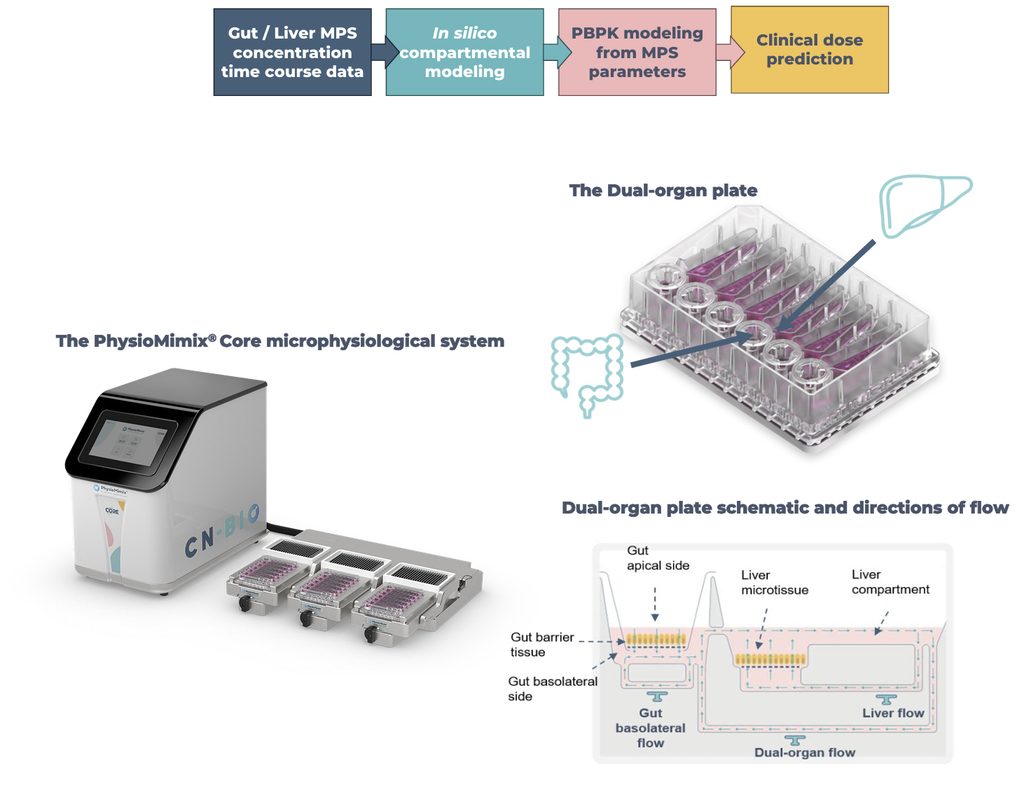
Dextromethorphan was evaluated using tissues from three donors. The assay resolved donor-specific differences in oral bioavailability and captured functional differences in CYP-mediated metabolism among the donors.

See the full dataset behind the model
The poster sets out the dextromethorphan oral bioavailability data in full, showing how differences in metabolism across three donors affected the fraction of an oral dose reaching the circulation in the linked gut/liver model.
Although a three-donor study cannot characterize population-level variability, it can establish whether the assay resolves donor-specific differences. What they demonstrate is analytical resolution: the assay can distinguish individuals within the same experimental system, using the same tissue architecture, the same flow conditions, and the same analytical method. That is the property being tested, and it is a prerequisite for the larger donor panels that would follow.
What the linked configuration adds
The gut and liver compartments can be run individually or fluidically connected, and a compound can be dosed onto the apical side of the gut barrier or directly into the circulating medium. Running both dosing routes in the same plate generates the exposure data needed to calculate oral bioavailability under matched tissue and experimental conditions. Donor-specific effects can therefore be assessed within a matched experiment, rather than inferred by comparing independently generated datasets run months apart in different systems.
For dextromethorphan, the dominant contribution of CYP2D6-mediated hepatic metabolism is already well characterized. What it added was the step between the enzyme and the exposure: how much each donor’s metabolic capacity changed the fraction of an oral dose reaching the circulation, measured in human tissue.
That matters most for compounds without dextromethorphan’s decades of clinical data. A well-characterized probe provides a reference compound for assessing method performance. Its practical value lies in application to candidate drugs for which the magnitude and mechanism of exposure variability are unknown.
What measured variability changes for FIH planning
A The MPS does not replace PBPK modeling. It provides experimentally linked inputs against which model assumptions and predictions can be assessed. Concentration-time data generated by the MPS can support model-based estimation of Fa, Fg, and Fh for use in PBPK simulations. Donor-specific Fa, Fg, and Fh estimates derived from one connected human system provide an experimental basis for evaluating PBPK predictions. This reduces reliance on inputs assembled across separate experiments.
We have previously described the integration of in silico tools with organ-on-a-chip data through a publication. In that work, Fa, Fg, and Fh estimates derived from gut/liver experiments were used to predict midazolam oral bioavailability, with the prediction falling within the observed clinical range. The same computational tools are now available through our ADME services portfolio.
Donor-resolved Gut/Liver MPS data can be used alongside physiologically based pharmacokinetic modeling to test assumptions about intestinal and hepatic disposition before first-in-human dosing. This comparison can help identify the mechanisms that require further study and refine predictions of exposure variability. Download our infographic to see how the gut and liver compartments are connected, dosed, and sampled during an oral bioavailability study.
If you are investigating variability in drug metabolism and want to discuss how a linked Gut/Liver-on-a-chip model could fit into your program, contact our team to arrange a conversation.
References
- US Food and Drug Administration. Drug Development and Drug Interactions: Table of Substrates, Inhibitors and Inducers. https://www.fda.gov/drugs/drug-interactions-labeling/drug-development-and-drug-interactions-table-substrates-inhibitors-and-inducers
- Capon DA, Bochner F, Kerry N, Mikus G, Danz C, Somogyi AA. The influence of CYP2D6 polymorphism and quinidine on the disposition and antitussive effect of dextromethorphan in humans. Clin Pharmacol Ther. 1996;60(3):295-307. doi:10.1016/S0009-9236(96)90056-9
- Jacqz-Aigrain E, Funck-Brentano C, Cresteil T. CYP2D6- and CYP3A-dependent metabolism of dextromethorphan in humans. Pharmacogenetics. 1993;3:197-204.
- Thummel KE. Gut instincts: CYP3A4 and intestinal drug metabolism. J Clin Invest. 2007;117(11):3173-3176. doi:10.1172/JCI34007
- van Herwaarden AE, et al. Knockout of cytochrome P450 3A yields new mouse models for understanding xenobiotic metabolism. J Clin Invest. 2007;117(11):3583-3592.
- Abbas Y, van Wyk M, Sze H, Christophi J, Spreen AA, Bliton RJ, Boazak EM, Kostrzewski T. A primary human Gut/Liver microphysiological system to estimate human oral bioavailability. Drug Metab Dispos. 2025;53:100130. doi:10.1016/j.dmd.2025.100130