

Resource > Scientific publications >
Quantitative Systems Pharmacology Approaches Applied to Microphysiological Systems (MPS): Data Interpretation and Multi-MPS Integration
Filed under: ADME and Drug metabolism

Summary
Yu et al. used a micro-perfused liver/immune MPS, a 3D coculture of primary human hepatocytes and Kupffer cells developed with CN Bio, to show that quantitative systems pharmacology models extract information from MPS experiments that traditional PK and PK/PD models leave behind. Accounting explicitly for hydrocortisone (HC) binding to human serum albumin (HSA) produced a metabolism rate constant for unbound drug that was independent of albumin concentration, while a receptor-level model of Toll-like receptor 4 (TLR4) dynamics explained why repeated LPS doses failed to re-stimulate cytokine release. A four-MPS interactome of gut, liver, kidney, and PD compartments was simulated to identify which operational and biological parameters govern drug distribution, exposure, and clearance across connected organ-on-a-chip models, providing researchers with a quantitative basis for designing multi-organ experiments rather than tuning them empirically.
Study facts at a glance
| Publication | Yu J, Cilfone NA, Large EM, Sarkar U, Wishnok JS, Tannenbaum SR, Hughes DJ, Lauffenburger DA, Griffith LG, Stokes CL, Cirit M. Quantitative Systems Pharmacology Approaches Applied to Microphysiological Systems (MPS): Data Interpretation and Multi-MPS Integration. CPT: Pharmacometrics & Systems Pharmacology. 2015;4(10):585-594. |
| DOI | 10.1002/psp4.12010 |
| CN Bio product used | The experimental work used a micro-perfused liver/immune MPS: primary human hepatocytes and Kupffer cells cultured as 3D microtissues in a perfused multiwell plate. |
| How the platform was used | The liver/immune MPS generated both experimental datasets in the paper: HC pharmacokinetics measured over 48 hours at low (1.25 mg/mL) and high (25 mg/mL) HSA concentrations, sampled across culture days 3 to 5 and days 5 to 7, and TNF-α and IL-6 secretion following repeated 48-hourly doses of LPS. The four-MPS interactome described in the same paper was modeled computationally and was not built experimentally. |
| Biological context | Human liver and innate hepatic immunity. A 3D coculture of primary human hepatocytes and Kupffer cells maintained under perfusion, in a non-diseased state, with an applied inflammatory stimulus. Application areas are drug metabolism, pharmacokinetics (PK), and inflammatory response modeling. |
| Comparator | A traditional one-compartment (non-mechanistic) PK model HC concentration over time (total and modeled unbound), HC metabolism rate constants, secreted TNF-α and IL-6, and simulated outputs from the four-MPS model: time for the pharmacodynamic (PD) MPS to reach 80% of the mixing chamber concentration.. |
| Key readouts | On the PhysioMimix platform: this study focused on a selected subset of seven key functional and injury-related endpoints, including albumin, urea, and cytochrome P450 (CYP) activity measured by P450-Glo assay at the end of maturation, followed by albumin, lactate dehydrogenase (LDH), alanine aminotransferase (ALT), aspartate aminotransferase (AST), CYP3A4 activity, bile acids, and interleukin 6 (IL-6) at final assessment. These endpoints were chosen to address the specific objectives of the study and represent only a subset of the wide range of biochemical, functional, imaging, and molecular analyses that can be performed on the PhysioMimix platform. Across the project, additional endpoints included ATP content and cell viability, while transcriptomics and liquid chromatography-mass spectrometry (LC-MS) profiling were incorporated as exploratory analyses. |
| Main interpretation | Mechanistic systems pharmacology models recover parameters from liver MPS experiments that traditional PK and PK/PD models cannot, and the same modeling framework can be used to specify flow rates, media volumes, dose levels, and sampling times before a multi-organ experiment is run. |
Table of Contents
Which CN Bio product was used?
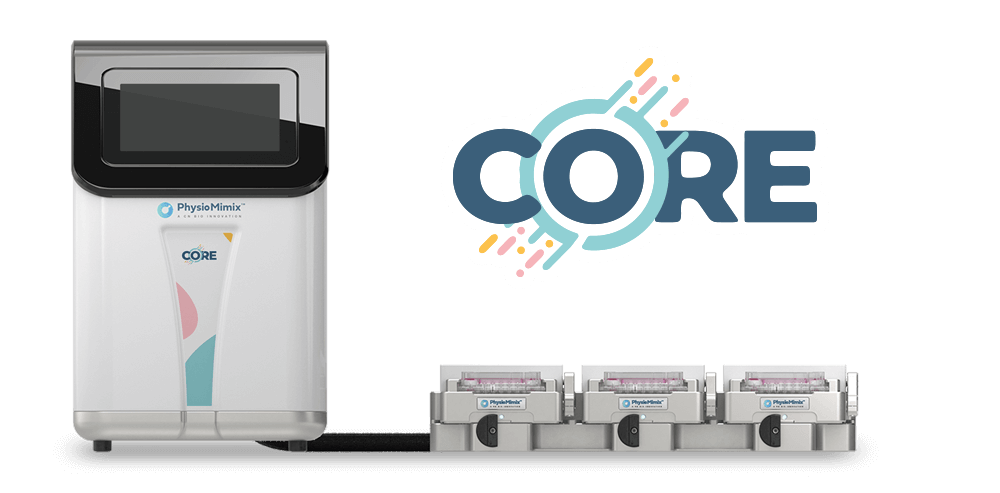
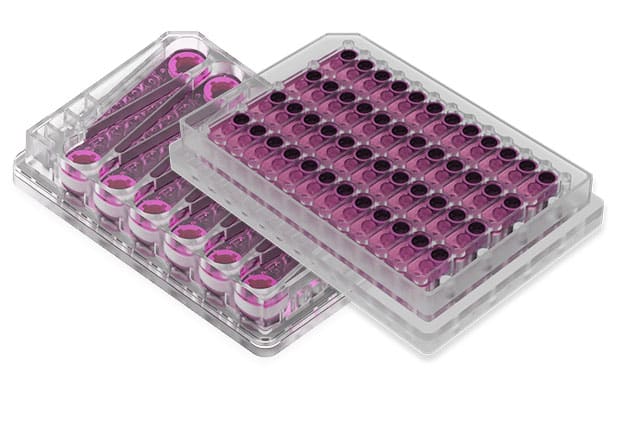
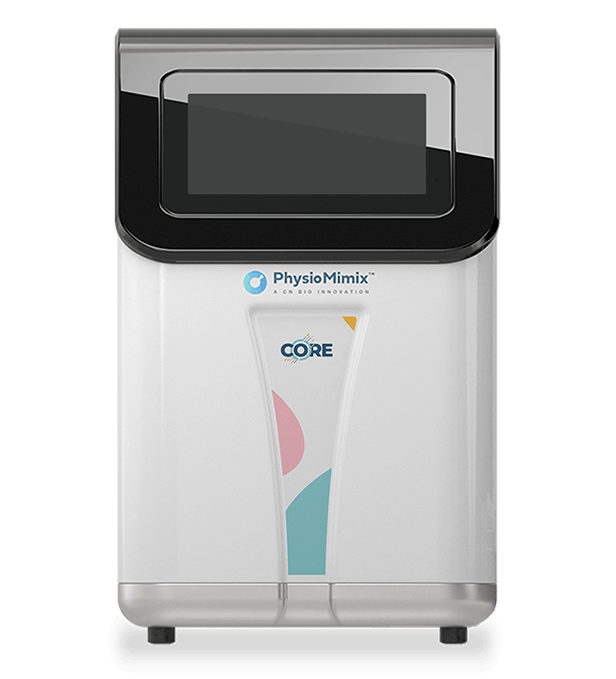
A micro-perfused liver/immune MPS: primary human hepatocytes cocultured with Kupffer cells as 3D microtissues in a perfused multiwell plate. The MIT liver-chip described here is now commercialized by CN Bio as the PhysioMimix® Liver-on-a-chip model, cultured in Multi-chip Liver plates on PhysioMimix Core microphysiological systems.
The platform was used for the experimental portion of the study. It generated HC pharmacokinetic profiles at two HSA concentrations across two culture windows, and TNF-α and IL-6 profiles under repeated LPS dosing with complete media changes every 48 hours (n = 3). The four-MPS interactome of gut, liver, kidney, and PD MPS combined with a mixing chamber was a computational construct used to investigate design and operating principles. All modeling and simulations were performed in MATLAB, with parameter estimation by genetic algorithm, two-way ANOVA for statistical testing, and global sensitivity analysis by Latin hypercube sampling and partial rank correlation coefficient.
What this paper is about
As the complexity of the in vitro models increased, the data they produced became harder to interpret. A perfused liver MPS containing multiple primary human cell types, recirculating media, and a defined culture volume behaves as a small physiological system rather than as a well, and the empirical PK/PD models built for in vivo studies were not designed to describe this. Without a model that represents protein binding, media volumes, flow rates, and receptor dynamics explicitly, an apparent rate constant measured in an MPS carries the fingerprint of the culture conditions that produced it, which limits how far the result can travel.
This gap was addressed using systems pharmacology approach, which carried more mechanistic detail than a traditional PK/PD model composed of three pillars. A PK case study of HC in the liver/immune MPS, compared what a traditional model and a mechanistic model each reported from identical data. A semimechanistic analysis of the inflammatory response to repeated LPS stimulation, tracking TNF-α and IL-6. And a theoretical four-MPS interactome that applied physiologically based pharmacokinetic (PBPK) principles to a connected gut, liver, kidney, and PD system, covering absorption, distribution, metabolism, and excretion in a way that connects directly to ADME applications for MPS. Together this set out a workflow in which computational models guide experimental design, interpret the resulting measurements, and lay groundwork for in vitro to in vivo translation (IVIVT).
What the researchers found
The mechanistic PK model separated drug binding from tissue function
HC binds HSA, and only the unbound fraction is available for metabolism. Equilibrium binding simulations predicted that 5% of HC was bound at 1.25 mg/mL HSA and 53% at 25 mg/mL. Fitted with a traditional one-compartment model, the apparent total metabolism rate constant depended on both HSA concentration (P = 0.039) and culture period (P = 0.0012), falling from 1.6 to 0.9 (× 10⁻² per hour) between low and high HSA on culture days 3 to 5. Fitted with the mechanistic model, the rate constant for unbound HC was unaffected by HSA concentration (P = 0.22), which is the behavior expected of a parameter describing hepatocyte metabolism rather than the assay medium.
Model choice did not remove the culture-period effect
The unbound rate constant remained dependent on culture period (P = 0.0082), rising between days 3 to 5 and days 5 to 7. The authors read this as evidence that MPS function over time must be characterized before experimental conditions are selected, a point that applies to any long-term perfused liver assay.
The two cytokines behaved differently, and repeated dosing did not reproduce the first response
An initial 1 µg/mL LPS dose produced a transient rise in TNF-α and a more sustained rise in IL-6. Both fell after the stimulus was removed at 48 hours with a complete media change. Subsequent LPS doses failed to stimulate a significant response. A semimechanistic model incorporating LPS binding to TLR4, internalization of the LPS-TLR4 complex, receptor recycling, and cytokine production by Kupffer cells reproduced these observations, attributing the lost response to receptor saturation and internalization coupled with relatively slow recycling.
The model then predicted a usable dosing window
Simulations indicated that a moderate 0.1 µg/mL LPS dose could induce a smaller but more sustained response across multiple doses, while doses below 0.01 µg/mL failed to elicit a substantial inflammatory response. The authors identify experimental validation across a range of LPS doses as the next step, which positions the model as a design tool for immune-mediated liver injury studies rather than as a validated predictor.
In the simulated four-MPS interactome, a small set of parameters governed system behavior
Mixing chamber outlet flow rate (Qmixing), PD MPS media volume (VPD), and intestinal permeability coefficient (P) were the primary drivers of tmixing,80. The effect of flow was nonlinear: raising Qmixing from zero to roughly 30 to 60 mL/day sharply reduced the time to uniform concentration, with little benefit beyond that. Low permeability compounds took longer to distribute evenly at any combination of Qmixing and VPD. For exposure, the fraction of unbound drug (fu) had the strongest effect on AUC0-48 in the PD MPS, with VPD, Qmixing, and P exerting modest effects, while the percentage of total drug cleared by 48 hours was driven by hepatic metabolism, renal excretion, fu, and gut permeability.
The study reports an exposure mismatch worth carrying forward
In the HC experiments the unbound fraction ranged from 47% to 95%, against roughly 7.5% unbound in human plasma. Media protein content is therefore an experimental variable that has to be represented in the model before an MPS-derived parameter can be scaled toward human PK.
Why the paper matters
For anyone running or designing MPS experiments, the practical value is in what the modeling framework lets you decide in advance. The simulations convert operating choices into predicted consequences: tmixing,80 indicates when the system is uniform enough to sample from the mixing chamber as a proxy for a tissue compartment, AUC0-48 indicates whether exposure will be sufficient to produce a pharmacodynamic effect, percentage cleared at 48 hours describes system PK, and the concentration profiles give Cmax and tmax in each compartment to guide sampling times. These are the questions that otherwise consume experimental runs.
The paper also makes a specific methodological point about parameter quality. A rate constant fitted without accounting for protein binding is conditional on the medium it was measured in, so it does not transfer between assay formats or toward human predictions. A mechanistic parameter such as the unbound metabolism rate constant is a candidate for scaling, provided the accompanying biological metrics (cell numbers, media-to-tissue ratios, organ size, plasma protein concentrations) are handled properly. That two-step pattern, where the MPS supplies concentration data and computational models derive the parameters that feed onward analysis, is now standard practice in quantitative in vitro pharmacokinetics using connected gut and liver MPS and in later work estimating human oral bioavailability from a primary Gut/Liver MPS.
The four-MPS analysis is theoretical, and the authors are explicit that its conclusions relate to the particular interactome schema considered. Read as a design framework rather than as validation data, it explains why flow rate and media volume are treated as experimental parameters in multi-organ MPS work rather than as fixed hardware settings.
Key study takeaways
- The study used a micro-perfused liver/immune MPS, a 3D coculture of primary human hepatocytes and Kupffer cells, to generate HC pharmacokinetic data and LPS-induced cytokine data for systems pharmacology analysis.
- A mechanistic PK model that accounted for HC binding to HSA returned an unbound metabolism rate constant that was independent of HSA concentration (P = 0.22), whereas the traditional model returned an apparent rate constant that varied with it (P = 0.039).
- Compared with a traditional one-compartment PK model, the mechanistic model separated a medium property (protein binding) from a tissue property (hepatocyte metabolic capacity) within the same dataset.
- The workflow combined perfused MPS culture, HC concentration measurement, TNF-α and IL-6 quantification, mechanistic and semimechanistic model fitting in MATLAB, and global sensitivity analysis by Latin hypercube sampling and partial rank correlation coefficient.
- Simulation of a four-MPS interactome identified mixing chamber flow rate, PD MPS media volume, intestinal permeability, and unbound drug fraction as the parameters that govern uniformity, exposure, and clearance, supporting the use of model-guided design for multi-organ MPS studies.
- The unbound HC metabolism rate constant remained sensitive to culture period, and the four-MPS interactome was simulated rather than built, so the paper is most useful as a framework for experimental design and data interpretation rather than as translational validation.
Why this paper is worth reading
This paper is useful because it shows, with paired datasets and models, what is gained by writing the mechanism into the analysis of an MPS experiment. Researchers deciding how to analyze perfused liver MPS data will find a concrete demonstration of how protein binding, culture duration, and receptor dynamics change the parameters they report, and a reasoned argument for which of those parameters are candidates for scaling to human PK. Teams planning multi-organ work will find a sensitivity analysis that names the operating parameters worth varying and the ones that can be fixed, together with output metrics that map onto real design decisions: when to sample, how much exposure a dosing scheme will deliver, and how quickly a compound will distribute. As one of the earliest systematic treatments of systems pharmacology applied to MPS, it also provides the conceptual grounding for the modeling now routinely paired with MPS-derived ADME data.
FAQs
The publication does not name a commercial product. It describes a micro-perfused liver/immune MPS built from primary human hepatocytes and Kupffer cells in a perfused multiwell plate, developed with CN Bio Innovations, whose authors EM Large and DJ Hughes contributed to the study. CN Bio supplies this liver model today as the PhysioMimix Liver-on-a-chip, cultured in Multi-chip Liver plates on PhysioMimix Core microphysiological systems.
The liver/immune MPS was used to measure HC pharmacokinetics over 48 hours at low (1.25 mg/mL) and high (25 mg/mL) HSA concentrations, sampled across culture days 3 to 5 and days 5 to 7, and to measure TNF-α and IL-6 secretion following LPS doses of 1 µg/mL repeated every 48 hours with complete media changes. The four-MPS interactome in the same paper was simulated computationally, not built on the platform.
The biological model was a 3D coculture of primary human hepatocytes and Kupffer cells maintained under perfusion, representing human liver tissue and its resident innate immune compartment. The study addressed drug metabolism and pharmacokinetics, and LPS-driven hepatic inflammation, rather than a specific disease indication.
The main finding was that mechanistic systems pharmacology models interpret liver MPS data more usefully than traditional PK/PD models: accounting for HC binding to HSA yielded an unbound metabolism rate constant independent of albumin concentration, and a TLR4 receptor model explained the loss of TNF-α and IL-6 response to repeated LPS doses. Simulation of a four-MPS interactome then identified the operational and biological parameters that control drug distribution, exposure, and clearance across connected MPSs.
The study compared a traditional one-compartment PK model with a mechanistic PK model, both fitted to the same HC dataset from the liver/immune MPS. The unbound HC fraction in human plasma, approximately 7.5%, was used as an in vivo reference point. The paper does not compare the MPS against static culture, an animal model, or an alternative platform.
Readouts were HC concentration over time (total and modeled unbound), fitted metabolism rate constants, and secreted TNF-α and IL-6, together with simulated metrics from the four-MPS model: tmixing,80, AUC0-48 for unbound drug in the PD MPS, percentage of total drug cleared at 48 hours, and Cmax and tmax in each compartment.
The paper is useful for researchers who need to interpret perfused liver MPS data quantitatively or design multi-organ MPS experiments, because it shows how mechanistic modeling separates culture conditions from tissue function and how sensitivity analysis identifies which operating parameters matter. Its four-MPS conclusions are theoretical and specific to the interactome considered, so the paper is best used as a design and interpretation framework rather than as translational validation.
Full citation
Yu J, Cilfone NA, Large EM, Sarkar U, Wishnok JS, Tannenbaum SR, Hughes DJ, Lauffenburger DA, Griffith LG, Stokes CL, Cirit M. Quantitative Systems Pharmacology Approaches Applied to Microphysiological Systems (MPS): Data Interpretation and Multi-MPS Integration. CPT: Pharmacometrics & Systems Pharmacology. 2015;4(10):585-594. DOI: 10.1002/psp4.12010.
Related products and services
Contract research services
Discover how to utilize our cross-species models to inform next-step decision making via our DILI in vitro Contract Research Services here.
Add PhysioMimix Core in your lab
To develop your own cross-species Liver MPS models, you will need: