




Resource > Scientific publications >
Comparative study demonstrating the strength of PhysioMimix for prediction of cholestatic DILI
Filed under: DILI and Safety toxicology
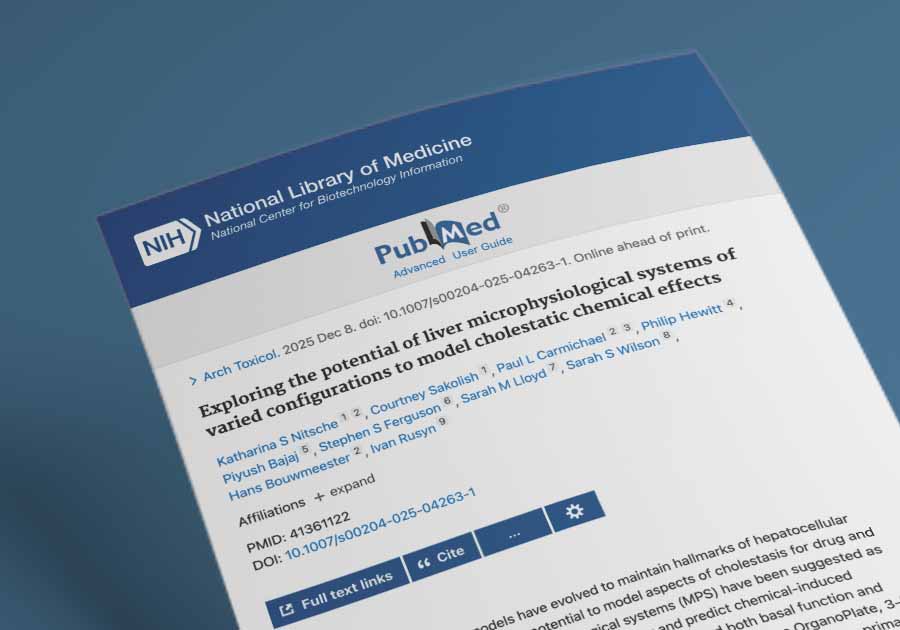
This publication by Nitsche et al., in Archives of Toxicology (2025) provides a detailed mechanistic evaluation of different liver microphysiological systems versus 2D static cultures for cholestatic DILI prediction.
TEX-VAL (Texas A&M Tissue Chip Validation Centre), research “Exploring the potential of liver microphysiological systems of varied configurations to model cholestatic chemical effects” showcases how the PhysioMimix® Liver microphysiological system (MPS) outperforms other MPS and traditional 2D liver cell cultures using three well characterized cholestatic agents.
Publication overview
This study provides a rigorous side by side assessment of 2D cultures performance against three MPS configurations, the 2-lane and 3-lane OrganoPlate and the PhysioMimix Liver-12 plate (LC12). Multiple cell types were evaluated: primary human hepatocytes (PHH), HepaRG cells, and iPSC-derived hepatocytes using multiple endpoints measurements. Their research evaluates how different MPS architectures, cell sources, and culture formats influence bile acid biology, transporter regulation, metabolic function, and mechanistic injury pathways.
A comprehensive panel of cholestasis‑relevant endpoints are analysed, including:
- Bile acid synthesis, conjugation, and transport
- Transporter regulation (BSEP, MRP2/3, NTCP, OATPs)
- Nuclear receptor signaling (FXR, PXR, CAR)
- Hepatocellular stress and mitochondrial injury pathways
- Functional biomarkers (albumin, urea, CYP activity)
This cross‑platform analysis highlights:
1) How biological fidelity varies across systems
2) The configurations best suited for mechanistic cholestasis research.
The findings within this publication demonstrate that not all liver models are equal for the same Context of Use (CoU), demonstrating the superior mechanistic and functional performance of PhysioMimix Liver-12 (LC12) plates in evaluating cholestatic drug effects that cause drug-induced liver injury (DILI) – a major challenge in drug safety assessment.
Key findings
PhysioMimix® Liver-12 (LC12) Primary human hepatocytes (PHH) and HepG2 Demonstrate Superior Mechanistic and Functional Performance
1. Superior Long‑Term Hepatic Function and Metabolic Competence
Compared with other configurations, over 30 days tested in the PhysioMimix LC12 PHHs and HepG2 cells maintained:
- Higher albumin and urea production
- More stable CYP450 activity
- Stable bile acid secretion
This is because the PhysioMimix LC12 platform’s microenvironment supports:
- Improved nutrient and oxygen distribution
- Reduced shear stress compared with perfusion‑heavy systems
- A more physiologically relevant environment for PHHs
These advantages directly contribute to the system’s biological fidelity, supporting the reliable interpretation of mechanistic endpoints and chronic exposure studies.
2. Only PhysioMimix PHHs Detected Altered Bile Acid Secretion
Across all three cholestatic test agents tested (Bosentan, 2-Octynoic acid, alpha-naphthyl isothiocyanate), only the PhysioMimix LC12 PHH system detected a reduction in bile acid secretion, a key mechanistic hallmark of cholestasis.
This sensitivity to early‑stage perturbations in bile acid homeostasis is essential for predictive cholestatic DILI modeling.
3. Human‑Relevant Bile Acid Conjugation Profiles
A major mechanistic distinction highlighted in the study:
- PhysioMimix HepG2 cultures predominantly produced taurine‑conjugated bile acids, which are less representative of human physiology
- PhysioMimix LC12 PHH cultures produced glycine‑conjugated bile acids, the dominant conjugates in humans
This difference is critical because bile acid conjugation patterns influence toxicity mechanisms, transporter interactions, and downstream injury pathways.
4. Early Detection of Sub‑Cytotoxic Mechanistic Perturbations
PhysioMimix LC12 PHHs detected:
- Early bile acid accumulation
- Early transcriptional shifts
- Early metabolic suppression
…at concentrations where other systems showed minimal or no response. This early sensitivity is crucial for mechanistic toxicology and risk assessment.
5. More Clinically Aligned Dose–Response Relationships
PhysioMimix LC12 PHHs produced dose–response curves that more closely matched:
- Clinical exposure thresholds
- Known cholestatic potency rankings
- Human‑relevant EC50/IC50 values
This translational alignment strengthens confidence in the model’s predictive value.
6. Higher Reproducibility Across Donors
The study reports lower inter‑donor variability and greater experimental consistency in LC12 PHH cultures compared with other MPS configurations—critical for screening, mechanistic studies, and cross‑study comparisons.
Why You Should Read It
Drug-induced liver injury is a leading cause of drug development failure. This research highlights that while multiple platforms can maintain liver function, the PhysioMimix LC12 platform provides superior sensitivity for predicting complex toxicities such as cholestasis.
Cholestatic toxicity remains one of the most challenging DILI subtypes to model in vitro. For scientists seeking a physiologically relevant, mechanistically informative liver MPS, the evidence strongly supports LC12 as a leading platform. By recreating the dynamic microenvironment of the liver, PhysioMimix Liver-12 plate provides researchers with a more reliable platform for toxicology testing and drug safety assessment.
Read the Full Publication
Explore the complete findings in the open access article: “Exploring the potential of liver microphysiological systems of varied configurations to model cholestatic chemical effects” Nitsche et al., Archives of Toxicology (2025).
PhysioMimix in your laboratory
To explore cholestatic chemical effects using PhysioMimix in your laboratory you will need: