



Resource > Scientific publications >
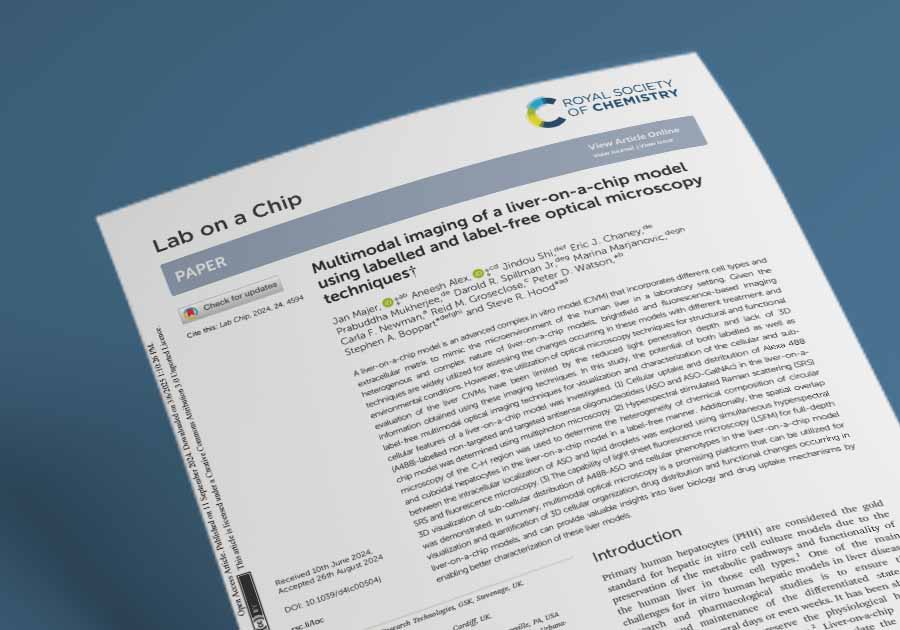
Multimodal imaging of a liver-on-a-chip model using labelled and label-free optical microscopy techniques
Filed under: ADME and Oligonucleotide delivery
Summary
The PhysioMimix® system was used to generate a perfused human liver-on-a-chip complex in vitro model containing primary human hepatocytes and Kupffer cells for studying antisense oligonucleotide uptake and distribution. The researchers combined labelled and label-free optical microscopy techniques to show that multiphoton fluorescence microscopy, stimulated Raman scattering microscopy, and light sheet fluorescence microscopy could provide deeper, three-dimensional insight into cellular organization, drug localization, hepatocyte morphology, and chemical heterogeneity than conventional single-photon fluorescence imaging.
The main finding was that N-acetylgalactosamine-conjugated antisense oligonucleotide showed significantly higher uptake than non-targeted antisense oligonucleotide after 1 hour at 2 μM, while non-targeted antisense oligonucleotide surpassed the conjugated form by 4 hours and at higher concentrations. The paper matters as it demonstrates how advanced imaging can help characterize liver-on-a-chip models for pharmacokinetic/pharmacodynamic research, therapeutic cargo delivery studies, and mechanistic analysis of drug uptake in human-relevant liver MPS.
Study facts at a glance
| Publication | Jan Majer, Aneesh Alex, Jindou Shi, Eric J. Chaney, Prabuddha Mukherjee, Darold R. Spillman Jr, Marina Marjanovic, Carla F. Newman, Reid M. Groseclose, Peter D. Watson, Stephen A. Boppart and Steve R. Hood. Multimodal imaging of a liver-on-a-chip model using labelled and label-free optical microscopy techniques. Lab on a Chip. 2024. 24:4594–4608. |
| DOI | 10.1039/d4lc00504j |
| CN Bio product used | PhysioMimix® System and PhysioMimix® LC12 |
| How the platform was used | The PhysioMimix system was used to culture and dose a perfused liver-on-a-chip model containing primary human hepatocytes and Kupffer cells, maintained at a flow rate of 1 μL/s, for antisense oligonucleotide uptake and imaging studies. Human liver-on-a-chip complex in vitro model using primary human hepatocytes and Kupffer cells in a 10:1 ratio, with antisense oligonucleotide uptake studied in cuboidal and circular hepatocyte morphologies. PBS control, non-targeted antisense oligonucleotide versus N-acetylgalactosamine-conjugated antisense oligonucleotide, one-photon fluorescence microscopy versus multiphoton and light sheet fluorescence microscopy, and circular versus cuboidal hepatocyte morphology. Cellular and subcellular antisense oligonucleotide distribution, A488 fluorescence intensity, three-dimensional cellular organization, imaging depth, hepatocyte morphology, chemical composition by stimulated Raman scattering microscopy, and spatial overlap between antisense oligonucleotide and lipid droplets. The study showed that multimodal optical imaging can visualize and quantify drug distribution, cellular organization, and phenotype-specific differences in a human liver-on-a-chip model, supporting deeper characterization of complex in vitro liver models. |
| Biological context | Human liver-on-a-chip complex in vitro model using primary human hepatocytes and Kupffer cells in a 10:1 ratio, with antisense oligonucleotide uptake studied in cuboidal and circular hepatocyte morphologies. |
| Comparator | PBS control, non-targeted antisense oligonucleotide versus N-acetylgalactosamine-conjugated antisense oligonucleotide, one-photon fluorescence microscopy versus multiphoton and light sheet fluorescence microscopy, and circular versus cuboidal hepatocyte morphology. |
| Key readouts | Cellular and subcellular antisense oligonucleotide distribution, A488 fluorescence intensity, three-dimensional cellular organization, imaging depth, hepatocyte morphology, chemical composition by stimulated Raman scattering microscopy, and spatial overlap between antisense oligonucleotide and lipid droplets. |
| Main interpretation | The study showed that multimodal optical imaging can visualize and quantify drug distribution, cellular organization, and phenotype-specific differences in a human liver-on-a-chip model, supporting deeper characterization of complex in vitro liver models. |
Which CN Bio product was used?
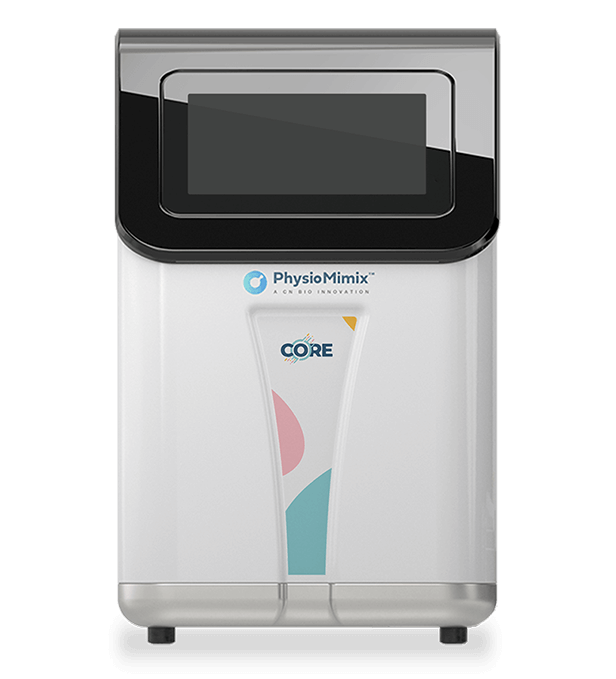
The study used the PhysioMimix system from CN Bio Innovations to conduct cell culture work and antisense oligonucleotide dosing of liver complex in vitro model scaffolds. The liver-on-a-chip model consisted of open-well bioreactors housing collagen-coated scaffolds with a porous filter base, a pneumatic micropump, and a reservoir to maintain nutrient flow through the tissue bed.
Primary human hepatocytes and Kupffer cells were seeded onto scaffolds at 6×10⁵ primary human hepatocytes and 6×10⁴ Kupffer cells in the MPS on day 0. The cells were maintained under flow at 1 μL/s, treated on day 7 with A488-labelled non-targeted antisense oligonucleotide or A488-labelled N-acetylgalactosamine-conjugated antisense oligonucleotide, and fixed at defined post-treatment time points for multimodal optical imaging.
Find out more about CN Bio Liver-on-a-chip models here
Find out more about CN Bio ADME assays here
What this paper is about
This paper addresses a key limitation in evaluating liver-on-a-chip models: conventional brightfield and fluorescence imaging can show changes in cells, but limited light penetration and lack of three-dimensional information restrict structural and functional characterization of thick, heterogeneous complex in vitro models.
The researchers studied a perfused human liver-on-a-chip MPS containing primary human hepatocytes and Kupffer cells. The model was used to investigate uptake and intracellular localization of A488-labelled non-targeted antisense oligonucleotide and A488-labelled N-acetylgalactosamine-conjugated antisense oligonucleotide, a hepatocyte-targeting format designed to engage the asialoglycoprotein receptor on hepatocyte cell membranes.
The study compared conventional single-photon fluorescence microscopy with advanced optical methods, including simultaneous label-free autofluorescence multiharmonic microscopy, multiphoton fluorescence microscopy, hyperspectral stimulated Raman scattering microscopy, simultaneous stimulated Raman scattering and fluorescence microscopy, and light sheet fluorescence microscopy. The intended application was improved visualization and quantification of three-dimensional cellular organization, drug distribution, and phenotype-associated functional differences in liver-on-a-chip models.
What the researchers found
The study reported that single-photon fluorescence microscopy could detect A488-labelled non-targeted antisense oligonucleotide on the scaffold surface and inside scaffold pores, but signal intensity decreased with imaging depth. The authors attributed this reduction to scattering of excitation and fluorescence photons through microtissue formations, which limited the ability of conventional fluorescence microscopy to evaluate antisense oligonucleotide distribution across the depth of the liver-on-a-chip model.
Simultaneous label-free autofluorescence multiharmonic microscopy enabled visualization of cellular features in scaffold pores up to 150 μm below the scaffold surface. This showed that multiphoton microscopy could provide deeper, label-free structural information from liver-on-a-chip microtissues than conventional single-photon fluorescence imaging.
Multiphoton fluorescence microscopy showed non-uniform cellular uptake of non-targeted antisense oligonucleotide and N-acetylgalactosamine-conjugated antisense oligonucleotide. At one hour after 2 μM treatment, the N-acetylgalactosamine-conjugated antisense oligonucleotide group had significantly higher A488 fluorescence intensity than the non-targeted antisense oligonucleotide group. At four hours, non-targeted antisense oligonucleotide uptake surpassed the conjugated form. At one hour, higher concentrations of 10 μM and 50 μM also showed higher uptake for non-targeted antisense oligonucleotide than for the N-acetylgalactosamine-conjugated form.
In cuboidal hepatocytes, the study found significantly higher N-acetylgalactosamine-conjugated antisense oligonucleotide uptake than non-targeted antisense oligonucleotide uptake at one hour. The authors confirmed that antisense oligonucleotide signal was primarily localized to nuclei-like structures, with additional high-contrast fluorescence on cell membranes and minimal cytoplasmic signal in cuboidal hepatocytes.
Hyperspectral stimulated Raman scattering microscopy showed chemical differences between hepatocyte morphologies. Circular hepatocytes appeared lipid-rich, while cuboidal hepatocyte cytoplasm appeared more protein-rich. The study also found that intracellular trafficking of fluorescently labelled antisense oligonucleotide and lipid droplets did not overlap based on simultaneous stimulated Raman scattering and fluorescence imaging.
Light sheet fluorescence microscopy enabled full-depth three-dimensional visualization of antisense oligonucleotide distribution and cellular phenotypes across approximately 250 μm of scaffold pore depth. The authors reported that light sheet fluorescence microscopy could image deeper cellular features than the multiphoton approaches tested in the study, although interpretation depended on the quality and specificity of fluorescent staining.
Why the paper matters
This paper is useful for researchers using liver-on-a-chip models because it shows how advanced optical microscopy can add spatial and three-dimensional information that soluble biomarker assays and conventional fluorescence imaging may not provide. In the context of drug discovery and pharmacokinetic/pharmacodynamic research, the ability to map where a therapeutic cargo enters cells, how uptake varies with time and concentration, and how localization differs across cell morphologies can improve mechanistic understanding of compound behavior in complex liver models.
The study adds evidence that liver-on-a-chip imaging workflows can distinguish biologically relevant heterogeneity within the same model. Cuboidal and circular hepatocytes showed differences in morphology, chemical composition, and antisense oligonucleotide distribution. This matters because the authors argue that cuboidal hepatocytes more closely reflect liver hepatocyte morphology in vivo, making phenotype-aware imaging important for interpreting uptake and trafficking data.
The paper also supports the practical value of combining labelled and label-free methods. Fluorescence imaging tracked A488-labelled antisense oligonucleotide localization, stimulated Raman scattering provided label-free chemical information, and light sheet fluorescence microscopy enabled deeper three-dimensional visualization. Together, these methods provide a more complete characterization framework for liver MPS used in therapeutic delivery research.
Key study takeaways
- The study used the PhysioMimix system to culture and dose a perfused human liver-on-a-chip model containing primary human hepatocytes and Kupffer cells.
- The liver-on-a-chip model supported investigation of non-targeted antisense oligonucleotide and N-acetylgalactosamine-conjugated antisense oligonucleotide uptake under controlled flow.
- Single-photon fluorescence microscopy detected labelled antisense oligonucleotide, but signal decreased with depth, limiting assessment of three-dimensional distribution in scaffold pores.
- Multiphoton imaging visualized liver-on-a-chip cellular features up to 150 μm below the scaffold surface and quantified non-uniform antisense oligonucleotide uptake across cells.
- N-acetylgalactosamine-conjugated antisense oligonucleotide showed significantly higher uptake than non-targeted antisense oligonucleotide after one hour at 2 μM, while non-targeted antisense oligonucleotide showed greater uptake at later time points and higher concentrations.
- Stimulated Raman scattering microscopy separated circular and cuboidal hepatocyte phenotypes in a label-free manner by revealing differences in lipid-rich and protein-rich cellular composition.
- Light sheet fluorescence microscopy achieved full-depth three-dimensional visualization of antisense oligonucleotide localization and cellular phenotypes across approximately 250 μm of scaffold pore depth.
- The findings support multimodal optical imaging as a characterization approach for liver-on-a-chip models used to study therapeutic cargo delivery, drug uptake mechanisms, and pharmacokinetic/pharmacodynamic behavior.
Why this paper is worth reading
This paper is useful because it provides a practical imaging framework for researchers who need more than endpoint biomarker measurements from liver-on-a-chip experiments. It shows how multiphoton fluorescence microscopy, stimulated Raman scattering microscopy, and light sheet fluorescence microscopy can be combined to evaluate drug distribution, cellular phenotype, scaffold depth, and chemical heterogeneity in a perfused human liver MPS. For scientists developing antisense oligonucleotide delivery strategies or using liver-on-a-chip models for drug discovery, the study helps clarify which imaging approaches can reveal spatial uptake patterns that conventional fluorescence microscopy may miss.
FAQs
The study used the PhysioMimix system from CN Bio Innovations for cell culture work and antisense oligonucleotide dosing of liver complex in vitro model scaffolds.
The PhysioMimix system was used to maintain primary human hepatocyte and Kupffer cell co-cultures in a perfused liver-on-a-chip model. Cells were cultured on collagen-coated porous scaffolds, maintained at 1 μL/s flow, treated with A488-labelled antisense oligonucleotide formats, and fixed for multimodal imaging.
The main finding was that multimodal optical imaging enabled deeper visualization and quantification of antisense oligonucleotide distribution, cellular organization, and phenotype-specific differences in a liver-on-a-chip model. N-acetylgalactosamine-conjugated antisense oligonucleotide showed significantly higher uptake than non-targeted antisense oligonucleotide after one hour at 2 μM, while non-targeted antisense oligonucleotide showed greater uptake at four hours and at higher concentrations.
The study compared non-targeted antisense oligonucleotide with N-acetylgalactosamine-conjugated antisense oligonucleotide, phosphate-buffered saline controls, circular versus cuboidal hepatocyte morphologies, and conventional single-photon fluorescence microscopy with multiphoton, stimulated Raman scattering, and light sheet fluorescence microscopy approaches.
The main readouts included A488 fluorescence intensity, three-dimensional cellular distribution, imaging depth, hepatocyte morphology, nuclear and cytoplasmic antisense oligonucleotide localization, stimulated Raman scattering chemical signatures, lipid droplet distribution, and spatial overlap between antisense oligonucleotide and lipid signals.
This paper is useful for researchers because it shows how labelled and label-free multimodal optical imaging can characterize drug uptake and cellular heterogeneity in liver-on-a-chip models. The workflow supports mechanistic studies of therapeutic cargo delivery, pharmacokinetic/pharmacodynamic behavior, and model quality in human liver microphysiological systems.