




• Skip to main content
  • Skip to footer
UK Plans to phase out animal testing UK Plans to phase out animal testing
  • About us
  • News
  • Events
  • Careers
cn-bio-organ-on-a-chip-logo
  • Products
    • PhysioMimix® Core Microphysiological System
    • Consumables
      • PhysioMimix® Multi-chip plates
      • 3D validated cells
      • NASH-in-a-box
    • Organ-on-a-chip models
    • Gut/Liver-on-a-chip
    • Lung-on-a-chip
    • Support packages
  • Applications
    • Disease modeling
    • Safety toxicology
    • ADME
  • Services
    • Non-Alcoholic Steatohepatitis
    • Drug-Induced Liver Injury
    • ADME
  • Technology
  • Resources
  • Company
    • About us
    • Events
    • News
    • Careers in Biotech
  • Contact us

Explore our solutions


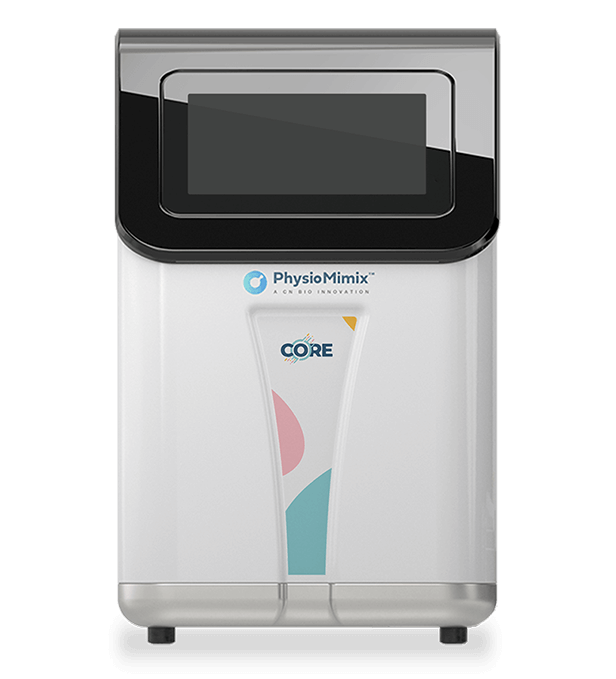
PhysioMimix® is a suite of hardware, consumables and assay protocols that enable you to recreate complex human biology and accurately predict human drug responses.

PhysioMimix Core

cnb1476_physiomimix-core_mark_mocks_system_v2
Learn more

Consumables

Multi-chip plates
3D validated cells
NASH-in-a-box
Learn more

Models

Single-organ models
- Liver-on-a-chip model
- Lung-on-a-chip model
Multi-organ models
- Gut/Liver-on-a-chip models

Support packages

PhysioMimix® support packages

Discover the applications


Investigate the validated core application areas that our PhysioMimix® products and services support

Learn more

Disease modeling

Metabolic dysfunction-associated steatohepatitis
Hepatitis B
Pulmonary infection
Learn more

Safety toxicology

Drug-induced liver injury
Immune-mediated liver injury
Learn more

ADME

Drug absorption
Drug metabolism
Drug bioavailability
Oligonucleotide delivery
Learn more

Studies as a service


Our team will work collaboratively with you to design a study around your research goals and generate actionable data within weeks

Learn more
icon-nash-1-150x150.png MASLD/MASH
icon-dili-tox-150x150.png Drug-induced liver injury
icon-adme-150x150.png ADME

WORD+ 2026 -World Organoid & Organ-on-a-chip Research Day

January 15, 2026

Event > Conference >

WORD+ 2026 -World Organoid & Organ-on-a-chip Research Day


The 4th annual World Organoid & Organ-on-a-chip Research Day, a premier international gathering dedicated to advancing research in organoids and Organ-on-a-chip technologies, brings together leading scientists, innovators, and industry experts to explore breakthroughs in disease modeling, regenerative medicine, drug discovery, and organoid intelligence.

With insightful talks, hands-on training sessions, and collaborative discussions aimed at shaping the future of predictive in vitro models, it provides a platform for networking, learning, and driving innovation.
cnb1558 word 2026 event logo v1 | WORD+ 2026
4- 5 February, 2026
Cambridge, UK
Book a meeting

We’re presenting at the 4th Annual WORD+ 2026


Visit our posters:

Title: Utilization of a Liver MPS to investigate human drug ADME

Poster No: 31

Date: 04 Feb, 2026, Wednesday

Time: 10:35

Presenter: Alexandra Morse

More info

Utilization of a Liver MPS to investigate human drug ADME

Microphysiological systems (MPS), also known as Organ-on-a-chip (OOC) have recently
gained attention for their ability in accurately predicting human physiological data,
enabling a deeper understanding of disease progression, drug responses, and
therefore clinical outcomes. Animal models poorly predict human data resulting in
toxicity issues and drug failure ultimately highlighting the importance of utilizing
OOC systems more commonly within research. This additionally aligns with the FDA’s
new roadmap to reduce animal testing and increase adoption of non-animal
methods.
Our perfused PhysioMimix® System incorporates primary human hepatocyte (PHH) cells, and tailored media which promotes 3D tissue formation to accurately recapitulate a liver tissue environment. Once the MPS is established, a broad range of drug ADME behaviours can be studied. Here, we focus on two specific small molecule drugs, Midazolam and Temocapril, as well as looking at the delivery of oligonucleotide therapeutics into PHH cells.

Title: Predicting human oral bioavailability in vitro: a combined primary human gut/liver MPS and mechanistic modelling approach

Poster No: 35

Date: 05 Feb, 2026, Thursday

Time: 13:00

Presenter: Dr Yassen Abbas

More info

Predicting human oral bioavailability in vitro: a combined primary human gut/liver microphysiological system and mechanistic modelling approach

Evaluating oral bioavailability (F) is crucial for understanding the pharmacokinetics of new drug candidates. However, animal models often fail to accurately predict human oral bioavailability, as shown in a seminal study involving 184 compounds (R2 = 0.34).

To enhance the translation of drug efficacy and safety data from in vitro to in vivo, microphysiological systems (MPS) have emerged, capable of fluidically connecting organs essential for modeling human drug ADME.

Here, we introduce a Dual-organ MPS with six wells, each containing two compartments – a Transwell®-based primary intestinal epithelial monolayer (RepliGut® Planar) and a 3D liver microtissue (primary human hepatocytes).

This Gut/Liver MPS, which simulates first-pass metabolism, is combined with a mechanistic mathematical model to estimate human oral bioavailability and its components: the fraction absorbed (Fa), the fraction escaping gut wall elimination (Fg), and the fraction escaping hepatic elimination (Fh).

We investigated the pharmacokinetics of midazolam because both the gut and liver play well-established roles in its metabolism. We then compared this to a Gut/Liver MPS model that uses Caco-2 cells in the gut model.

After combining and fluidically coupling the gut and liver tissues in the Dual-organ MPS, we simulated oral and intravenous (IV) drug delivery routes. We quantified midazolam and its primary metabolite, 1’-hydroxymidazolam, by performing LCMS on the media samples collected from the liver and gut apical compartments over a 72-hour period.

A 2-compartment mechanistic model was developed to describe the changes in parent and metabolite concentrations. We fitted the model to the LCMS data and used Bayesian inference to investigate the parameter space, determining the upper and lower bounds for various ADME parameters, including intrinsic clearance of the gut and liver, and apparent permeability.

We estimated Fa, Fg, Fh, and F from model simulations of experimental data and established scaling methods using model parameter estimates.

The model estimation of F was found to be 0.53 for the primary Gut/Liver MPS, which aligns with the range observed in humans (0.096 to 0.68, with a mean of 0.31(2)). In contrast, F was estimated to be 0.66 for the Caco-2/Liver MPS.

Using a primary gut model improved the estimation of F, as no metabolism was observed in Caco-2 cells, leading to a higher prediction of Fg compared to the primary Gut/Liver MPS.

Here, we present a Dual-organ MPS capable of simulating oral and IV drug delivery routes. When combined with mathematical modelling, using midazolam, we demonstrate the ability to mechanistically profile and to extract multiple ADME parameters including oral bioavailability and its components, Fa, Fg and Fh from a single experiment. 

Title: Broad assessment of primary hepatocyte and stellate donors for use in MPS and in vitro assays to model human liver disease

Poster No: 33

Date: 04 Feb, 2026, Wednesday

Time: 15:45

Presenter: Gemma Farquhar

More info

Broad assessment of primary hepatocyte and stellate donors for use in MPS and in vitro assays to model human liver disease

Primary human hepatocytes (PHHs) remain the gold standard for in vitro liver research and drug development, with widespread use across the industry. One benefit of PHH use in research is the ability to explore the role of donor variability. However, differences
in tissue quality and PHH isolation can contribute to data variance and a lack of reproducibility.

Hepatic stellate cells (HSCs) play a central role in maintaining PHH function and can transition into a myofibroblast-like phenotype,
driving fibrosis and early disease progression.Validating HSC donors in 2D culture helps assess baseline activation and production of fibrosis-related markers, supporting their use in liver
disease modelling.


Microphysiological systems (MPS), also known as Organ-on-a-chip (OOC), are designed to replicate the functional biomarkers of cells and tissues in a more physiologically relevant manner by culturing
primary human cells on perfused 3D scaffolds.

In this study, we aimed to characterise a broad range of PHH donors in 3D platforms to identify high-quality sources for use in translational MPS. We also validated HSC donors in 2D to understand their baseline activation state and responsivity to fibrotic inducers and suitability for liver disease modelling.
Together, this work evaluates both PHH and HSC donor
performance to support reliable donor selection for 3D MPS applications, with particular attention to insulin sensitivity as a key feature of metabolic disease modelling.


Meet the team at WORD+ 2026

Emily USE THIS ONE | WORD+ 2026

Dr. Emily Richardson

Biology Group Leader

Dr. Emily Richardson is driving development of MPS for toxicology and safety assessment. She led the development of CN Bio’s Lung and Lung/Liver models for infectious disease research and inhaled therapeutics, and spearheaded multiple other collaborative and grant-funded programmes, published peer-reviewed papers, and contributed to advancing regulatory acceptance of Organ-on-a-chip.

Her work bridges complex cell biology and real-world drug discovery, informed by a PhD from the University of Leicester in 3D cell culture for metastatic lung cancer and a BSc in Biochemistry and Molecular Medicine degree from the University of Nottingham.

    Yass 2 1 | WORD+ 2026

    Dr. Yassen Abbas

    Biology Group Leader

    Dr. Yassen Abbas is advancing Organ‑on‑a‑chip applications in ADME and oral bioavailability, digital twins, and CAR‑T therapy models. His background includes the European Space Agency, a PhD and postdoc at the University of Cambridge in tissue‑engineered models of human reproduction. He has authored peer‑reviewed publications, including five first‑author papers, and is named on three patent applications.
      Alex BW | WORD+ 2026

      Alexandra Morse

      Research Assistant

      Alexandra Morse, Research Assistant at CN Bio, is passionate about drug discovery and pioneering advanced research technologies. After earning a BSc in Immunology and Pharmacology from the University of Strathclyde, Glasgow, she completed an MRes in Clinical Research at Imperial College London, building a strong foundation across multiple scientific disciplines and mastering an array of specialised lab techniques.

      Her experience includes time in Germany working in an Immunology lab, where she investigated myeloid stem cell development using flow cytometry. At CN Bio, Alexandra has contributed to numerous projects, from studying drug bioavailability using the PhysioMimix dual organ (Gut/Liver) model to developing a model to study drug uptake within liver cells.

        Gemma bw | WORD+ 2026

        Gemma Farquhar

        Research Assistant

        Gemma Farquhar, Research Assistant at CN Bio, brings a strong foundation in cellular and molecular biology to her role. With a BSc in Biomedical Sciences and an MRes in Regenerative Medicine and Stem Cells, she combines academic excellence with a passion for scientific discovery.

        At CN Bio, Gemma plays a key role in innovative research projects, focusing on developing and refining the metabolic dysfunction associated steatohepatitis (MASH) assay using the PhysioMimix® Liver-on-a-chip model to replicate key disease characteristics. Her expertise spans numerous advanced cell culture techniques, with a particular enthusiasm for fluorescent imaging.

          WORD+ 2026 -World Organoid & Organ-on-a-chip Research Day

          Book a meeting

          Speak to our experts

          Request a meeting with one of our OOC experts to see how our products and services can support your studies

          Request a meeting

          Footer

          CN Bio logo

          332 Cambridge Science Park, Milton Road
          Cambridge, CB4 0WN

          UK: +44 (0) 1223 737 941

          US: +1 415 523 4005

          Privacy | Cookies | Regulatory | Accessibility
          Website terms | Terms of sale

          Product Recycling

          ©2025 CN Bio Innovations Ltd
          Registered No. ‍06517359. VAT No. GB978184563

          Latest news

          • CN Bio to participate in 3Rs Collaborative-led project with FDA to build confidence in Liver MPS for DILI – now ISTAND accepted! January 25, 2026
          • Taking organoids to the next level January 14, 2026
          • UK plans to phase out animal testing faster in favor of alternative methods November 11, 2025
          Cyber Essentials Logo

          Modal Title