




Resource > Infographic >
A visual guide to improving oral bioavailability prediction
Why improving oral bioavailability prediction matters & how human-relevant models improve decision making confidence in lead optimization & candidate selection
Filed under: Drug bioavailability
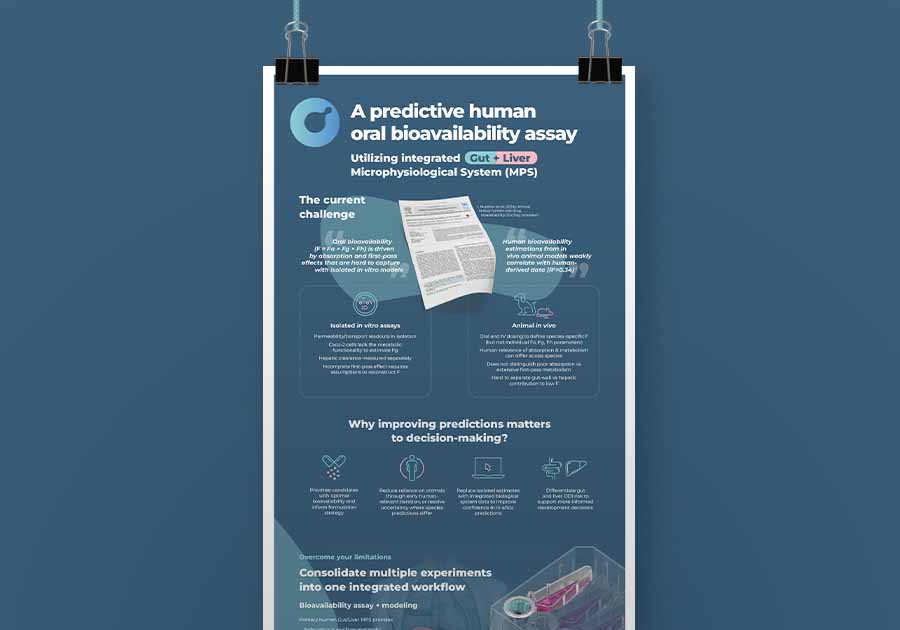
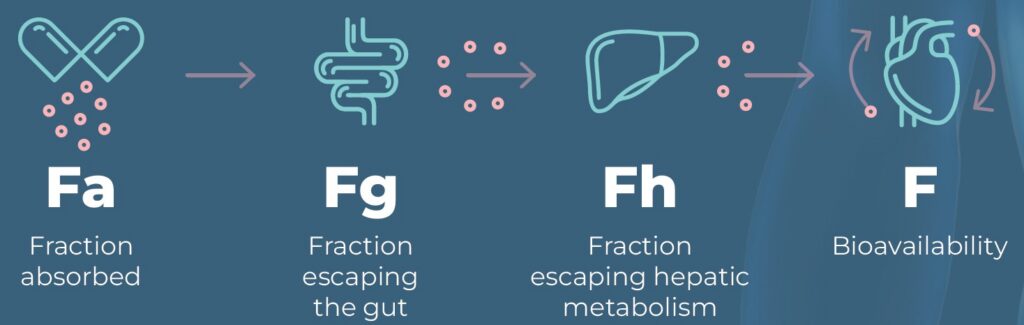
Oral bioavailability prediction is challenging because bioavailability is not determined by a single measurement. It reflects the combined effects of three fractions: the fraction absorbed across the intestinal barrier (Fa), the fraction escaping gut wall metabolism (Fg), and the fraction escaping hepatic first-pass metabolism (Fh).
Every preclinical model has strengths and limitations, but most measure only part of this sequence. Predicting human oral bioavailability therefore requires assumptions when Fa, Fg, and Fh are recombined into an overall human exposure estimate.
This infographic explores the factors that determine oral bioavailability, highlights where conventional in vitro and preclinical approaches can leave uncertainty, and explains how a fully human Gut/Liver microphysiological system can generate Fa, Fg, Fh, and overall bioavailability (F) data within a single experiment. Download the infographic to learn how these experimentally derived parameters can support IVIVE, PBPK modeling, and more informed human oral bioavailability predictions.
What you’ll discover
- How Fa, Fg, and Fh combine to determine oral bioavailability (F)
- Where isolated in vitro assays and animal studies leave uncertainty in a human exposure estimate
- The readouts a Gut/Liver MPS returns, including permeability, efflux ratio, intrinsic clearance, and metabolite profiling
- How MPS concentration data feeds computational modeling and PBPK workflows
- The discovery and development stages where a better prediction changes a decision
Why oral bioavailability remains challenging
Absorption, intestinal metabolism, transporter activity, and hepatic first-pass clearance all influence how much of an orally administered compound reaches the systemic circulation. Conventional oral bioavailability prediction workflows assess these mechanisms using separate assays before reconstructing overall bioavailability (F) from the individual results.
Each assay performs its intended function well. Caco-2 monolayers reliably measure intestinal permeability and efflux, but lack the metabolic functionality required to estimate Fg. Liver microsomes and suspension hepatocytes measure hepatic clearance, but do not capture the intestinal processes that precede it. As neither approach reproduces the complete first-pass sequence, the resulting human oral bioavailability estimate depends on the assumptions used to integrate data from separate assays.
Animal studies address part of this uncertainty by determining species-specific F through paired oral and intravenous dosing. However, they do not resolve the individual contributions of Fa, Fg, and Fh, while species differences in absorption and metabolism can limit translation to humans.
This creates a practical challenge for drug developers. When F is low, it can be difficult to determine whether the primary cause is poor intestinal absorption or extensive first-pass metabolism. Distinguishing gut wall metabolism from hepatic first-pass clearance is harder still. These mechanisms require different development strategies, ranging from formulation changes that improve absorption to structural optimization that reduces metabolic clearance.
For a more detailed exploration of how the two organs interact within a connected system, read our blog on human Gut/Liver models for ADME.
Why improving oral bioavailability prediction matters to decision-making
Better decisions during lead optimization
Understand the mechanisms controlling exposure before committing resources and in vivo animal studies to candidate progression.
Greater confidence in translation
Build evidence in models that reflect human physiology, and replace isolated estimates with parameters generated in an integrated system.
An earlier view of drug-drug interaction risk
Profile gut and liver contributions separately to assess whether metabolic or transporter-mediated interactions could affect exposure, intended use, or progression decisions.
More informed dose and formulation decisions
Inform formulation strategy, risk management, and first-in-human dose and dosing schedule decisions with human-relevant data.
From MPS data to a human PK prediction
The PhysioMimix Bioavailability assay works in two steps.
First, the Gut/Liver MPS generates concentration-time data from oral and intravenous dosing in one experiment, using a primary human jejunum model interconnected with a primary human liver model under perfusion.
Second, mechanistic computational models built on the biology of that system fit the data to return ADME parameters, including permeability, efflux ratio, intrinsic clearance, Fa, Fg, Fh, and F. Those parameters then serve as inputs to PBPK modeling alongside drug chemistry, physiological data, and other in vitro results, supporting in vitro to in vivo extrapolation (IVIVE). Our blog on integrating in silico tools with organ-on-a-chip covers the modeling step in more detail.
Discuss your bioavailability challenge with an expert
Whether you are investigating absorption, metabolism, clearance, transporter effects, or translational relevance, our scientific team can help identify the most appropriate approach.
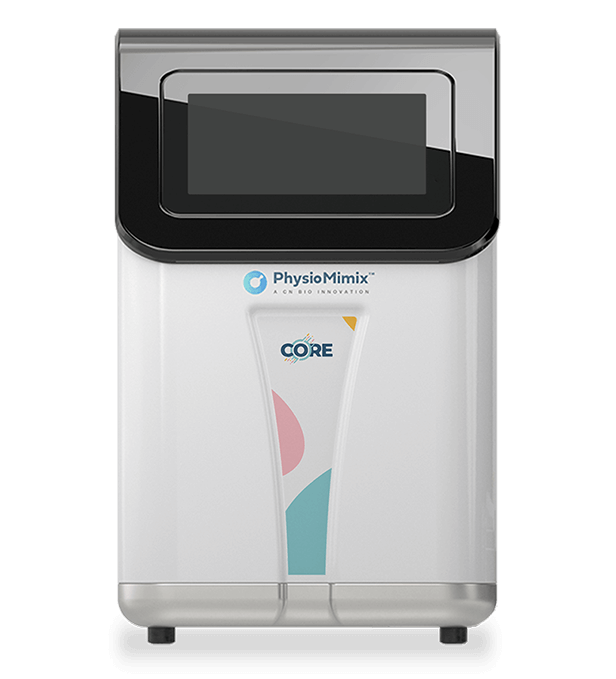
Run the assay in your own laboratory with PhysioMimix Core and the Bioavailability assay kit: Human 18, or outsource your study to our ADME Contract Research Services.
Related Content
Application note: Connecting the gut and liver
Publication: A primary human Gut/Liver MPS to estimate human oral bioavailability
Webinar: MPS and In Silico Modeling: The next generation of bioavailability prediction