




Resource > Webinars >
What is Organ-on-a-chip Technology? An introduction to OOC.
Series 1 Episode 1
Filed under: General OOC
Video content if present
This webinar discusses the revolutionary technology behind Organ-an-a-chip (OOC) systems
Watch this webinar to learn
- The evolution of pre-clinical drug testing tools and current challenges
- Opportunities for OOC systems across the drug discovery process
- Building microphysiological systems – understanding and control cellular microenvironments
Current strategies for preclinical drug discovery produce potential therapies that fail 90% of the time in clinical trials. To improve this situation, we need new models for research.
These platforms could improve many aspects of the pre-clinical drug discovery process, enhancing throughput, reproducibility and usability. Our speaker, CN Bio’s Vaish Manoharan introduces OOC systems and show how researchers are using these systems to understand cellular microenvironments.
In this webinar, Vaish discusses the current organ-on-a-chip ecosystem and how the CN Bio PhysioMimix® Systems are used for drug-drug interaction, ADME, Disease Modeling and precision medicine applications.
View our Q&A document from the live event.
Webinar Transcript
What is Organ-on-a-chip Technology? An introduction to OOC
00:00:00: Hello and thanks for joining us today for the latest Technology Networks webinar, The Future of Preclinical Drug Research and Introduction to Organ-on-a-chip.
00:00:09: I’m Holly Large, Editorial Assistant for Technology Networks, and I’m here to moderate the event.
00:00:14: I’m pleased to have Vaish Manoharan joining us today as your presenter.
00:00:18: A warm welcome to you.
00:00:20: Graduating with a Biomedical Science degree at Keele University and holding a Master’s in Immunology from Imperial College London, Vaish joined CN Bio in 2019.
00:00:29: She has over 9 years of cell culture experience, including working with 3D cell culture.
00:00:34: Following the webinar, we will have a Q&A session, and we welcome any questions that you may have.
00:00:40: You can submit questions for the Q&A session at any time during the presentation.
00:00:45: To ask a question, you should enter your question into the box on the left-hand side of your screen and click submit.
00:00:51: We will answer as many questions as possible during the time available.
00:00:55: For any questions we don’t have time to get to, we will be sure you are contacted offline with an answer.
00:01:00: If you experience any technical issues, please click the question mark in the top right-hand corner to request support.
00:01:07: Please remember, you can ask questions at any time, even whilst watching the webinar on demand.
00:01:12: So, without further ado, I will now hand over to Vaish.
00:01:151: Thank you, Holly, for the introductions.
Definition of Organ-on-a-chip Systems
00:01:17: Today, I will discuss why there has been an increased interest in Organ-on-chip (OOC) systems in the recent years.
00:01:24: In the recent years, the Organ-on-a-chip term has come into common use.
00:01:29: Others in the community may use microphysiological systems (MPS).
00:01:33: For simplicity, in this presentation, I will be using Organ-on-a-chip. The two terms are interchangeable.
00:01:40: I will then discuss how do OOC systems fit within the pharmaceutical industry.
00:01:46: I will present CN Bio’s Organ-on-a-chip system and highlight the application of the drug discovery process.
00:01:55: So, what is an Organ-on-a-chip system?
00:01:58: An Organ-on-a-chip system is an advanced in vitro model, typically featuring 3D cultures of human cells with fluid flow.
00:02:07: The goal is to grow cells in conditions, which match the human body; so, they will respond to drugs and other chemicals in the same way as a human would.
The Organ-on-a-chip Community
00:02:21: The OOC community.
00:02:23: The OOC community has matured over the past decade with the support of academic research, a number of spin-out companies, and significant engagement within the pharma industry.
00:02:36: There are different organizations and consortiums to help raise and promote the use of OOC Systems.
00:02:44: As an example, the Orchard Consortium. The goal of Orchard Consortium is to create a roadmap for OOC technology.
00:02:53: This identifies potential roadblocks and solutions, raise awareness, and to implement OOCs in science, R&D, and regulatory guidelines in Europe and elsewhere.
00:03:07: Academics have developed and published on many innovative OOC systems.
00:03:12: We are seeing OOC companies taking these systems and developing them towards commercial products and service offerings.
00:03:20: An ecosystem has begun to grow with industrial partners supporting development through technological expertise, financing, and pharma companies accessing technology through collaborations.
00:03:34:We are starting to see OOC systems being adapted and utilized on active drug discovery programs.
00:03:42: CN Bio has been part of this community for a decade with strong links to academia, biotech, and pharma companies.
The growing interest in Organ-on-a-chip
00:03:50: The rise in publications illustrates the growing interest in the field.
00:03:55: This has been mirrored by the founding of numerous OOC startups such as CN Bio.
00:04:01: We are now seeing publications from across academia, OOC vendors, and the pharma industry.
00:04:09: CN Bio is contributed to this growing evidence-based paper.
00:04:13: A paper has been accepted for publication with the University of Cambridge on our NASH (MASH) model and a paper in preparation with the FDA on the evaluation of microphysiological systems.
Comparison: Predicting human responses
00:04:26: So, why has there been an increased interest?
00:04:29: The biggest reason is that 90% of drugs, which enter clinical trial, fail to become approved medicines, as current pre-clinical methods such as conventional methods such as 2D cell culture, and animal models are not always effective tools to predict drug safety and efficacy.
00:04:50: Standard methods such as 2D monolayer cell cultures, which are overfed and do not represent physiological characteristics of an organ, cell type, or tissue.
00:05:02: There are many examples in which mouse and other animal models have been shown to be poor predictors of the response of human to new medicines.
00:05:13: This lack of translatability between animal and human data is a key challenge for the pharma industry.
00:05:22: Due to these issues, millions of pounds are wasted each year on the development of medicines which fail in the clinic.
00:05:30: To cut the cost of drug development, it’s important to improve the productivity of preclinical screening to enable a fail early, fail cheaply scenario, eliminating ineffective drug candidates as early as possible.
Organ-on-a-chip efficacy in drug development
00:05:43: So, the question is, how can OOC systems be placed within the drug discovery process?
00:05:52: OOC has applications throughout the drug discovery and development process, starting from the target discovery all the way through to supporting clinical development.
00:06:03 The CN Bio (PhysioMimix) System has enabled these applications right across the process.
00:06:10: For example, OOC models can be used for disease modeling during early discovery phases, identifying novel drug targets, and understanding the mechanisms underlying disease processes.
00:06:24: These same disease models could be additionally used to support clinical development and inform clinical trial design.
00:06:33: At CN Bio, we have developed advanced models of HBV and metabolic liver disease,which have been used by researchers to advance compounds through the development process.
00:06:49: Within DMPK, CN Bio’s OOC System has been used to determine the metabolism of compounds and in the future, multi-organ systems with inter-organ crosstalk, such as a Gut/Liver model, will be used for great levels of translation.
00:07:07: At CN Bio, we have a Gut/Liver model coming out soon, the TL6 (Dual-organ Plate), which I will discuss in further detail later on.
Precision Medicine
00:07:15: So why are we doing this?
00:07:17: Looking for the future, OOC has the potential to create a Patient-on-a-chip, enabling precision medicine with the response of an individual being predicted and treatments recommended.
PhysioMimix®
00:07:30: These systems will contain multiple microtissue structures representing various key organs, all with the same genetic background and are fluidically linked together, mimicking the flow of blood around the human body.
00:07:48: Now, I want to talk about our Organ-on-chip System, the CN Bio PhysioMimix.
00:07:56: The system was born out of a technological race sponsored by DARPA between MIT and Harvard.
00:08:04: The PhysioMimix System has been developed over numerous years and became commercially available two years ago.
00:08:12: The platform has been implemented into eight of the top 20 pharma [companies].
00:08:17:We have also collaborated with leading academic partners, including Imperial College London, and more recently with the Centre for Drug Evaluation and Research (CDER) at the FDA.
00:08:30: Just a note on this point, within this webinar series, there will be a webinar presented by the FDA on the strategies to evaluate MPS systems for drug development on the 15th of July.
00:08:46: CN Bio is developing a second instrument based on IP licensed from Vanderbilt University, which enable the accurate modelling of pharmacokinetics and drug dosing regimens in vitro.
PhysioMimix OOC product family
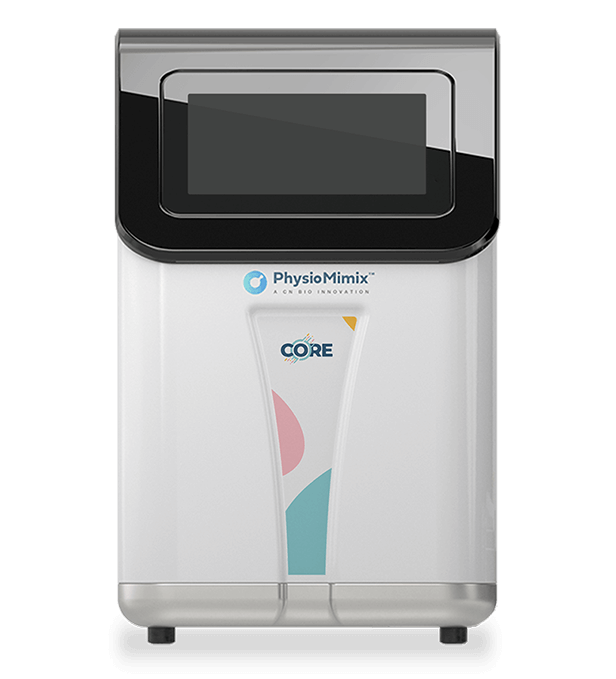
00:08:59: As you can see, the simplicity of the PhysioMimix platform is in its design.
00:09:05: The overall system includes a Controller, specifically designed to provide accurate microfluidic flow within the OOC plates.
00:09:13: The Docking Station, which supports multiple types of OOC plates and sits directly inside your incubator to maintain consistent cell conditions during your experiment.
00:09:26: Two docking stations can be added [to each Controller] to increase throughput as required, a unique feature of our system.
00:09:35: Our existing customers have commented on the ease-of-use and simplicity of setup [of the PhysioMimix System]. Therefore making it easy to transition from standard 2D cell culture to 3D microtissues.
PhysioMimix Organ-on-a-chip platform
00:09:46: We currently offer two different consumable OOC plates.
00:09:53: All plate types have an open well design, allowing simple access to cells and media throughout your experiments.
00:10:04: The T12 (Barrier Plate) is used to create a multicell-type barrier model, for example, the gut, lung, or skin.
00:10:12: It can then be used to model drug transport, toxicity, or disease mechanisms in these tissues.
00:10:21: The LC12 (Liver-12) is designed specifically for culture of liver cells and backed by extensive research from CN Bio and MIT.
The Liver-12 (LC-12) Plate: Unique design features
00:10:29: The LC12 (Liver-12)plate.
00:10:31: Each plate has 12 independent wells with micro pumps that allow a tunable flow rate.
00:10:37: It is PDMS-free, so there is low non-specific binding. CN Bio uses chemically inert COC, commonly used in cell culture plasticware.
00:10:50: Our plates come with pre-coated 3D scaffolds in each well that are specifically designed for the culture of multiple liver cell types.
The Barrier (T-12) Plate: Unique design features
00:11:03: The T12 (Barrier Plate), each plate again contains 12 independent wells to create barrier models using standard Transwells.
00:11:14: The micro pumps provides flow to the basal lateral side of the Transwells throughout the culture period.
00:11:21: The plate is flexible to accept pre-formed Transwell models or tissue models that can be developed under the presence of flow in the platform.
The role of microfluidics
00:11:34: Now let’s look at the fluidics which is the heart of the system.
00:11:40: When you seed your cells in the plate, the controller automatically directs the flow down into the scaffold to allow the cells to form the 3D structures over the first few hours of culture.
00:11:54: The flow then continuous to run throughout the experiment through the scaffold to provide biomechanical stimulus, oxygen, and nutrients to the cells.
00:12:07: For the T12 (Barrier Plate), flow on the basal lateral side of the Transwell promotes barrier models with more pronounced 3D topology.
00:12:15: For example, we have seen in our Gut model, flow acts to increase permeability, bringing the model closer to physiological parameters and therefore providing greater levels of translation.
00:12:31: On both plate types, media samples can be simply taken from each well and the 3D scaffolds or Transwells can be removed to allow analysis of the tissue structures.
Experimental Design
00:12:43: How does your typical experimental design work?
00:12:47: Let me give an example using our LC12 liver model.
00:12:52: You start with your cells of your interest. These could be your primary cells, cells originated from stem cells, or a more simplistic cell line, and seed them into the plates.
00:13:04: From day four onwards, a disease state can be induced.
00:13:08: So for example, introduction of a viral infection.
00:13:12: And at the appropriate time, drug dosing can be initiated.
00:13:17: We aim to dose compounds in a manner that closely represents the dosing regimens performed in patients.
00:13:24:We have successfully used a wide range of modalities in the platform.
00:13:29: Cells are typically cultured for a number of weeks and remain viable throughout, well beyond the classic cell culture methods.
00:13:43: After your experiment, data is generated using the media or tissue, so you can perform a wide range of standard endpoint analysis, for example, omics, microscopy, histology, and biomarkers.
00:13:57: You can obtain 1ml of medium to run various biomarker analysis and large-scale tissue on scaffolds to extract genetic material.
One solution for many problems
00:14:07: Our platform has been adopted and utilised in numerous applications within the pharma drug discovery and development process.
00:14:15: The CN Bio system falls in nicely as part of this roadmap.
00:14:21: So for example, our current customers are using these applications in disease modeling to study NASH (MASH), HBV, breast cancer metastasis in the liver.
00:14:32: We have our customers testing in toxicology to investigate the DNA damage.
00:14:37: And within DMPK, we have customers testing the human-specific metabolic profile of large and small molecules.
Commitment of OOC roadmap
00:14:51: As an innovative company, we always thrive to develop new products to help research with the Organ-on-a-a-chip community.
00:14:59: Here we have some products coming soon.
00:15:03: The TL6 (Dual-organ plate)is a true two organ plate where the flow rate will be adaptable for each organ to fully represent the microphysiology of the target organ.
00:15:16: We’ll be implementing a unique sensing solution to support real-time monitoring of the cell health and oxygen levels using biosensors.
00:15:26: This will provide an efficient mechanism for cell culture QC and provide valuable insight into cell viability.
Summary
00:15:38: Just to recap on the main points I have discussed today, OOC systems are becoming essential to support efficient drug development.
00:15:47: CN Bio Systems are adaptable, user-friendly, and cost-effective.
00:15:53: Regulators are now establishing strategies to evaluate OOC Systems.
00:15:58: Pharma, biotech, and academia are rapidly adopting the CN Bio system.
00:16:06: Thank you so much for listening.
00:16:08: We have a series of webinars coming up.
00:16:10: The next webinar will be presented by Dr. Michaeli Raka from the University of Cambridge, who will be discussing 3D NASH (MASH) models in our OOC system.
00:16:20: I’ll be happy to take any questions now.
00:16:24: Thank you very much, Vaish.
Speaker information:
 Vaish Manoharan
Account Manager (Former)
CN Bio