

Resource > Scientific publications >
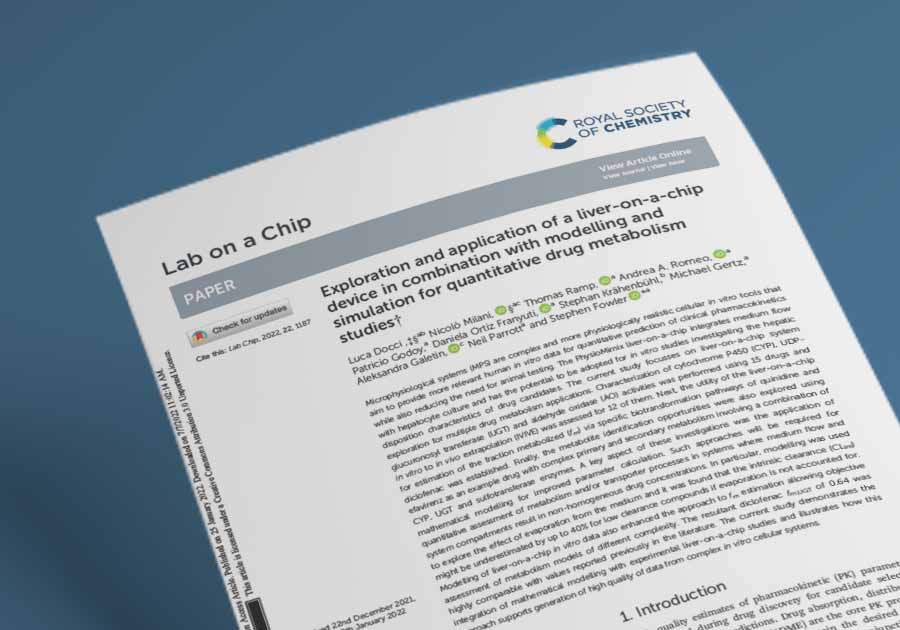
Exploration and application of a liver-on-a-chip device in combination with modelling and simulation for quantitative drug metabolism studies
Filed under: ADME and Drug metabolism
Summary
Researchers at Roche and academic partners used the CN Bio PhysioMimix® liver-on-a-chip, seeded with single-donor primary human hepatocytes in LC-12 plates, to measure drug metabolism for 15 compounds and to extract quantitative drug metabolism and pharmacokinetics (DMPK) parameters with mathematical modelling. The liver-on-a-chip measured intrinsic clearance (CL_int) across cytochrome P450 (CYP), UDP-glucuronosyltransferase (UGT), and aldehyde oxidase (AO) substrates, estimated the fraction metabolized (f_m) for quinidine and diclofenac, and detected the full efavirenz metabolite profile, while modelling showed that ignoring medium evaporation can underestimate CL_int by up to 40% for low-clearance drugs. The work matters because it sets out the cell-number normalization, evaporation correction, and model-selection steps needed to generate reliable clearance and f_m values from a perfused microphysiological system.
Study facts at a glance
| Publication | Docci L, Milani N, Ramp T, Romeo AA, Godoy P, Ortiz Franyuti D, Krähenbühl S, Gertz M, Galetin A, Parrott N, Fowler S. Exploration and application of a liver-on-a-chip device in combination with modelling and simulation for quantitative drug metabolism studies. Lab Chip. 2022;22:1187-1205. |
| DOI | 10.1039/d1lc01161h |
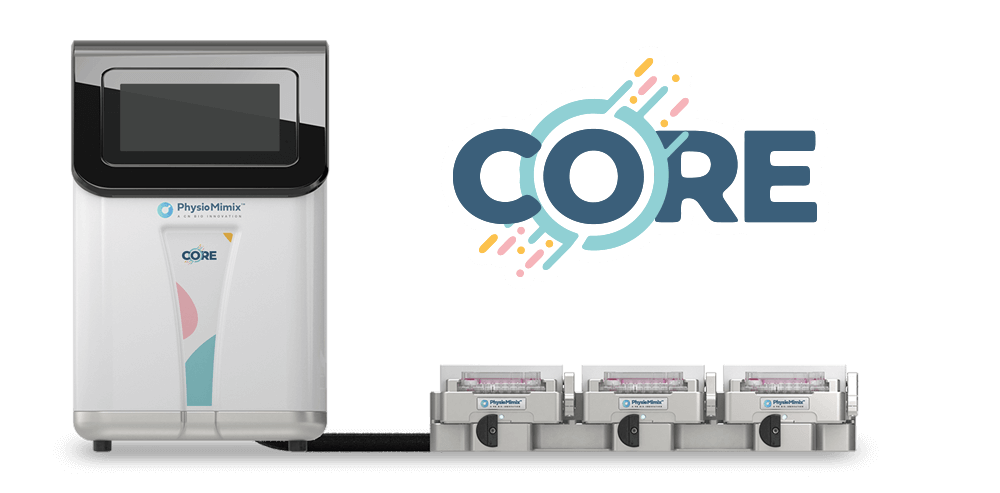
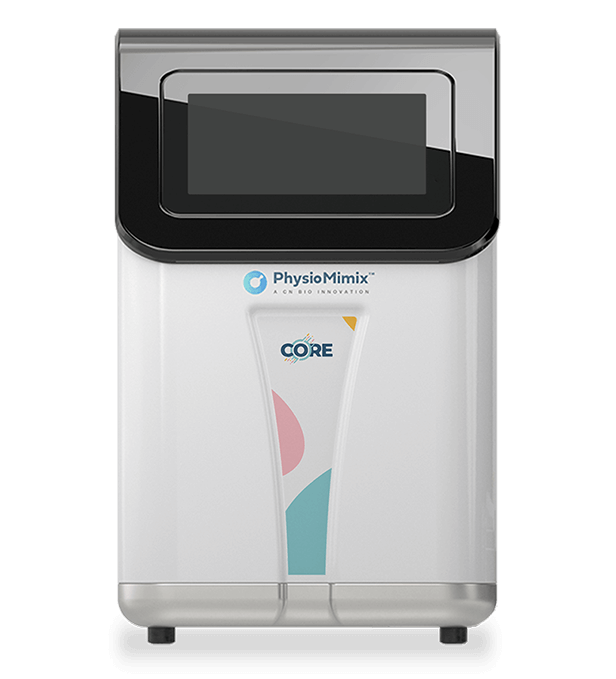
| CN Bio product used | PhysioMimix® LC12 and PhysioMimix Core System |
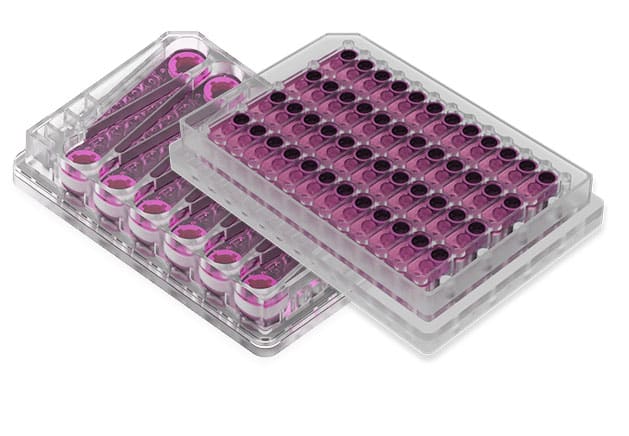
| How the platform was used | Single-donor primary human hepatocytes were cultured under continuous medium perfusion in LC-12 plates (1,800 μL accessible medium per well) for up to 96 hours, and serial medium sampling with liquid chromatography tandem mass spectrometry (LC-MS/MS) measured drug depletion and metabolite formation for intrinsic clearance, fraction metabolized, and metabolite identification. |
| Biological context | Human hepatic drug metabolism, studied with healthy single-donor primary human hepatocytes (lot Hu8264) in the liver-on-a-chip; a drug metabolism and pharmacokinetics (DMPK) study rather than a disease model. |
| Comparator | Suspended human hepatocytes and HepatoPac micropatterned co-cultured hepatocytes (intrinsic clearance), observed clinical clearance (in vitro to in vivo extrapolation), and a linear model versus an evaporation-corrected model. |
| Key readouts | Hepatocyte seeding efficiency and active cell number (total protein, albumin production rate), intrinsic clearance (CL_int) from drug depletion, in vitro to in vivo extrapolation (IVIVE) of hepatic clearance, fraction metabolized (f_m) for quinidine and diclofenac, and efavirenz metabolite identification. |
| Main interpretation | Combining the liver-on-a-chip with mathematical modelling produces quantitative DMPK parameters, and correcting for medium evaporation is necessary for accurate intrinsic clearance estimates of low-clearance drugs. |
Table of Contents
Which CN Bio product was used?
The study used the CN Bio PhysioMimix liver-on-a-chip, a microfluidic microphysiological system that perfuses medium across cultured hepatocytes, together with LC-12 consumable plates and the CN Bio controller, docking station, and drivers. Single-donor cryopreserved primary human hepatocytes (lot Hu8264) were seeded on the LC-12 plate scaffolds at between 400,000 and 650,000 cells per well (consensus 600,000) and pre-incubated for around 72 hours before treatment. Each well held an accessible medium volume of 1,800 μL, which allowed repeated medium sampling from the same well during incubations of up to 96 hours. The platform was central to the drug metabolism measurements, while separate assays (equilibrium dialysis for protein binding, LC-MS/MS for drug quantification) and in silico modelling supported the analysis.
What this paper is about
Standard in vitro systems for drug metabolism, including 2D plated hepatocytes, suspended hepatocytes, and liver microsomes, lose enzyme activity quickly and give poor clearance estimates for metabolically stable, low-clearance drugs. That limits quantitative prediction of human pharmacokinetics during candidate selection. This study evaluates whether the PhysioMimix liver-on-a-chip, which keeps hepatocytes under continuous perfusion, meets the minimum requirements for DMPK use and can support more demanding endpoints. It first develops the cell-number normalization and evaporation-correction methods, then tests the system across three application areas: intrinsic clearance and IVIVE for 15 drugs, fraction metabolized for quinidine and diclofenac, and metabolite identification for efavirenz. Mathematical modelling was used throughout for experiment planning and data analysis.
What the researchers found
The study reported the following, in order of importance:
Seeding and cell number: seeding efficiency averaged 52% (range 39 to 66.5%), leaving around 260,000 active hepatocytes per well at day 2. Albumin production rate (39 ± 8 μg per day per million cells) worked as a non-invasive marker to estimate the active cell number in each well, correcting for well-to-well differences.
Intrinsic clearance: CL_int was measured for four CYP substrates, seven UGT substrates, and one AO substrate. Values fell within 2-fold of suspended hepatocytes for 11 of 14 compounds and within 2-fold of HepatoPac for 8 of 13 compounds.
Evaporation correction: for low-clearance drugs (CL_int below 1 μL per min per million cells) with evaporation rates above 0.05 μL/min, a simple linear model underestimated CL_int. An evaporation model that accounted for medium loss reduced this underestimation by up to around 40% for tolbutamide and irinotecan.
IVIVE: predicted hepatic clearance was within 3-fold of observed values for 7 of 12 compounds (midazolam, quinidine, diclofenac, naloxone, oxazepam, tolbutamide, and lorazepam). Transporter substrates (telmisartan, repaglinide, zidovudine, and dextromethorphan) were under-predicted, consistent with the absence of active hepatic uptake and bile flow in the system.
Fraction metabolized: for diclofenac, the model showed a fraction metabolized by UGT (f_m,UGT) of 0.64, close to a literature value of 0.62 from human liver microsomes. For quinidine, the 3-hydroxyquinidine pathway f_m was estimated at 0.64 to 0.71 depending on model structure.
Metabolite identification: all four efavirenz metabolites reported in vivo were detected in the liver-on-a-chip, along with secondary and tertiary metabolites, indicating the system can support metabolite identification for low-turnover drugs. Repeated use: more than 80% of metabolic activity was retained at day 2. By day 4, CYP and AO activity fell to 47 to 51% of day 1, while UGT activity was better retained (62% for diclofenac, 70% for naloxone).
Why the paper matters
The paper gives a worked methodology for turning perfused liver-on-a-chip data into quantitative DMPK parameters rather than treating the device as a black box. It shows which experimental and modelling steps are needed: normalizing to active cell number using albumin, correcting for medium evaporation in long low-clearance incubations, and selecting model structures for fraction metabolized. It also shows where the system currently falls short, namely transporter-mediated clearance and single-donor variability. For drug metabolism scientists, this supports a clearer decision about when the liver-on-a-chip is suitable and how to interpret its data. The demonstration of f_m and metabolite identification is relevant because these endpoints are difficult for standard short-incubation systems to handle for metabolically stable drugs.
Key study takeaways
- The study used the CN Bio PhysioMimix liver-on-a-chip with LC-12 plates and single-donor primary human hepatocytes to measure drug metabolism for 15 compounds.
- Albumin production rate (39 ± 8 μg per day per million cells) worked as a non-invasive marker for active hepatocyte number, correcting for a seeding efficiency that averaged 52%.
- Intrinsic clearance from the liver-on-a-chip fell within 2-fold of suspended hepatocytes for 11 of 14 compounds and within 3-fold of observed clinical clearance for 7 of 12 compounds.
- Mathematical modelling that accounted for medium evaporation reduced intrinsic clearance underestimation by up to around 40% for low-clearance drugs such as tolbutamide and irinotecan.
- The system estimated a diclofenac fraction metabolized by UGT (f_m,UGT) of 0.64, close to the human liver microsome value of 0.62, and detected the full efavirenz metabolite profile including tertiary metabolites.
- Clearance of transporter substrates (telmisartan, repaglinide, zidovudine, and dextromethorphan) was under-predicted, and the single-donor design limits population representativeness, so pooled multi-donor hepatocytes and bile-flow capability are suggested for future work.
Why this paper is worth reading
This paper is useful because it sets out, step by step, how to generate trustworthy quantitative data from a perfused liver-on-a-chip. A drug metabolism scientist deciding whether to adopt the PhysioMimix liver-on-a-chip will find concrete guidance on normalizing to active cell number, correcting for evaporation in long low-clearance incubations, and choosing model structures for fraction metabolized. The paper also states the current limits of the system for transporter-mediated clearance, which helps set realistic expectations for candidate selection and drug-drug interaction work.
FAQ
The study used the CN Bio PhysioMimix liver-on-a-chip with LC-12 plates.
Single-donor primary human hepatocytes were seeded on the LC-12 plate scaffolds and cultured under continuous medium perfusion, with an accessible medium volume of 1800 μL per well. Serial medium samples were taken over incubations of up to 96 hours and analyzed by LC-MS/MS to measure drug depletion and metabolite formation.
The study modeled human hepatic drug metabolism using primary human hepatocytes in the liver-on-a-chip. It focused on drug metabolism and pharmacokinetics rather than a specific disease, using healthy single-donor hepatocytes.
The PhysioMimix liver-on-a-chip, combined with mathematical modelling, produced quantitative intrinsic clearance, fraction metabolized, and metabolite identification data. Correcting for medium evaporation prevented intrinsic clearance underestimation of up to 40% for low-clearance drugs.
Liver-on-a-chip intrinsic clearance was compared with suspended hepatocytes and HepatoPac micropatterned co-cultures, and predicted in vivo clearance was compared with observed clinical clearance. A linear model was compared with an evaporation-corrected model.
The main readouts were hepatocyte seeding efficiency and active cell number (total protein and albumin production rate), intrinsic clearance from drug depletion, in vitro to in vivo extrapolation of hepatic clearance, fraction metabolized for quinidine and diclofenac, and efavirenz metabolite identification.
The paper gives drug metabolism scientists a practical methodology for producing quantitative DMPK parameters from a perfused liver-on-a-chip, including cell-number normalization, evaporation correction, and model selection for fraction metabolized. It also states where the system is currently limited, such as transporter-mediated clearance.
Full citation
Related products and services
Contract research services
Discover how to utilize our cross-species models to inform next-step decision making via our DILI in vitro Contract Research Services here.
Add PhysioMimix Core in your lab
To develop your own cross-species Liver MPS models, you will need: