




Resource > Scientific publications >
Advanced pathophysiology mimicking lung models for accelerated drug discovery
Phan et al. (2023)
Filed under: Disease modeling
Summary
This paper used CN Bio’s PhysioMimix System with the multi-MPS12 plate to support dynamic basal media perfusion during culture of in vitro airway models representing healthy and COPD-relevant lung biology. The study found that model complexity and microcirculation influenced barrier function, tissue organisation, and disease-relevant phenotypes, supporting the use of more advanced perfused lung models for drug discovery, toxicity testing, and mechanistic respiratory research.
Study facts at a glance
| Publication | Thanh Huyen Phan, Huaikai Shi, Christopher E. Denes, Alexander J. Cole, Yiwei Wang, Yuen Yee Cheng, Daniel Hesselson, Susan H. Roelofs, Graham Gregory Neely, Jun-Hyeog Jang, Wojciech Chrzanowski. Advanced pathophysiology mimicking lung models for accelerated drug discovery. Biomaterials Research. 26 April 2023. 27(1):35. |
| DOI | 10.1186/s40824-023-00366-x |
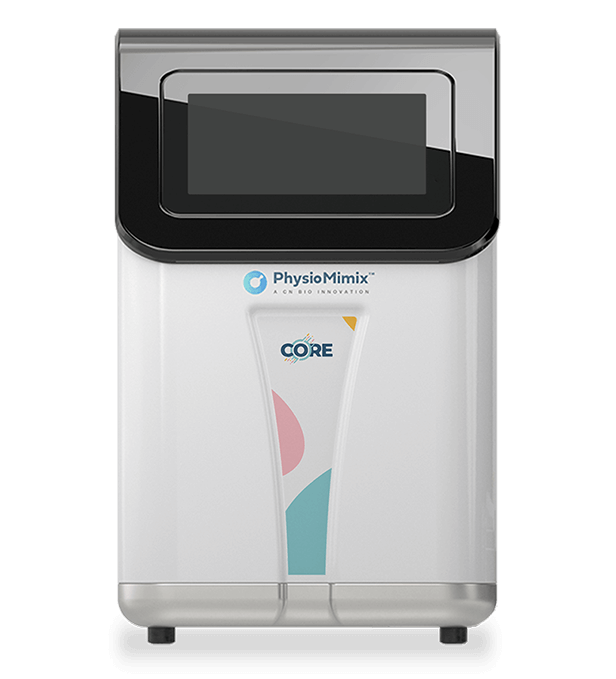
| CN Bio product used | PhysioMimix System with the multi-MPS12 plate |
| How the platform was used | Dynamic basal media flow at 0.5 µL/s during culture of airway cell mono-cultures and co-cultures |
| Biological context | Healthy airway and COPD-relevant airway models |
| Comparator | Matched static Transwell culture conditions |
| Key readouts | Barrier function, permeability, tight junctions, tissue structure, tissue composition, and cytokine secretion |
| Main interpretation | Model complexity and microcirculation are important context-of-use variables in lung research and drug discovery |
Which CN Bio product was used?
The study used CN Bio’s PhysioMimix System with the multi-MPS12 plate to provide dynamic basal media flow at 0.5 µL/s during culture of airway cell mono-cultures and co-cultures. In the experimental design, the platform served as a perfused lung microphysiological culture environment for healthy and COPD-relevant airway models and was evaluated alongside matched static Transwell culture conditions.
Learn more about PhysioMimix lung-on-a-chip models
Learn more about using PhysioMimix Core for disease modeling
Learn more about the PhysioMimix Core microphysiological system
What this paper is about
The paper addresses a central challenge in respiratory research: many existing preclinical models do not adequately reproduce the complexity of human lung tissue, its dynamic microenvironment, or disease-associated changes seen in chronic obstructive pulmonary disease (COPD). To address this, the authors developed a series of in vitro lung models intended to represent healthy airway tissue and COPD-relevant pathology by varying cell type, membrane properties, environmental conditions, cellular arrangement, and matrix composition.
The work combined static culture formats with dynamic perfusion on the CN Bio PhysioMimix platform. Early optimization used immortalised airway-related cell lines, while more human-relevant configurations used primary normal human bronchial epithelial cells, normal human lung fibroblasts, and diseased human bronchial epithelial cells from a COPD context.
What the researchers found
The healthy lung model formed a multilayered epithelium with continuous tight junctions, physiological barrier function, ciliated cells, and goblet cells. The COPD model reproduced disease-associated features including impaired barrier function, cilia depletion, and goblet cell overproduction.
The authors also describe a quality control framework that integrated real-time and end-point measurements of barrier function, permeability, tight junctions, tissue structure, tissue composition, and cytokine secretion. Within that framework, bioimpedance is described as a rapid single readout that emerged as useful during model evaluation.
Why the paper matters
A key contribution of the study is its fit-for-purpose framing. Rather than arguing that one model is always best, the paper links model design to intended application. The authors state that simpler 2D monolayer systems may be sufficient when the research question is limited to screening compounds for barrier function or permeability. By contrast, questions involving tissue regeneration, recovery of lung function, or deeper mechanistic investigation are presented as requiring greater tissue complexity and dynamic microcirculation.
This makes the paper relevant both as a respiratory disease-modelling study and as a methodological comparison. It supports the use of advanced perfused lung models when stronger physiological relevance and richer phenotyping are needed, while preserving a role for simpler systems in lower-complexity screening tasks.
Key study takeaways
- The paper establishes two classes of airway model, one representing healthy lung tissue and one representing COPD-like pathology, using human cell-based in vitro systems.
- In the healthy configuration, the model showed continuous tight junctions, physiological barrier function, multilayer epithelial structure, and the presence of ciliated and goblet cells.
- In the COPD configuration, the model showed dysfunctional barrier properties, cilia depletion, and goblet cell overproduction.
- CN Bio’s PhysioMimix system was used to introduce dynamic basal perfusion as part of the environmental optimisation strategy for the lung cultures.
- The study links model selection to context of use by arguing that simple barrier and permeability questions may be addressed with lower-complexity systems, whereas mechanistic and regeneration-focused questions require greater tissue complexity and microcirculation.
- The integrated quality control strategy combined real-time and end-point measurements, and the authors identify bioimpedance as a rapid and reliable readout within that framework.
Why this paper is worth reading
This paper is useful because it does more than describe a single advanced lung model. It explains how specific design choices, including cell source, co-culture architecture, membrane properties, extracellular matrix, and dynamic perfusion,shape what a lung model can validly be used for. For researchers working in respiratory disease, toxicology, or preclinical model development, it offers a practical framework for thinking about physiological relevance, quality control, and fit-for-purpose model selection.
FAQ
The study used CN Bio’s PhysioMimix 3D system with the multi-MPS12 plate.
The platform was used to provide dynamic basal media perfusion at 0.5 µL/s during culture of airway cell mono-cultures and co-cultures in a perfused lung microphysiological environment.
The paper developed in vitro airway models intended to represent healthy lung tissue and COPD-relevant pathology.
Yes, the study compared static and dynamic culture conditions. The authors evaluated dynamic perfusion on the CN Bio platform alongside matched static Transwell culture conditions.
The phenotype observed in the healthy model showed continuous tight junctions, physiological barrier function, multilayer epithelial structure, ciliated cells, and goblet cells.
The phenotype observed in the COPD model showed dysfunctional barrier function, depletion of ciliated cells, and overproduction of goblet cells.
This paper is useful because it links model complexity and microcirculation to context of use, helping researchers think more clearly about fit-for-purpose lung model selection for screening, mechanistic studies, toxicity assessment, and regenerative questions.