




Resource > Articles >
Organ-on-a-chip: a modernized toolbox for drug discovery challenges
Filed under: General OOC

The pharmaceutical industry continues to face the persistent challenge of high drug attrition. Even today, many promising drug candidates fail in clinical trials due to unforeseen toxicity, poor efficacy, or issues with absorption and metabolism. Traditional methods, such as simple in vitro models and in vivo animal testing, are often limited when it comes to predicting how a drug will behave in the human body, posing drug discovery challenges.
Reduce these limitations with Organ-on-a-chip
Organ-on-a-chip (OOC), also known as microphysiological systems (MPS), allows scientists to model human biology more accurately, to extract meaningful preclinical data in vitro, reducing the risks and costs of drug development, whilst minimizing the use of animal testing.
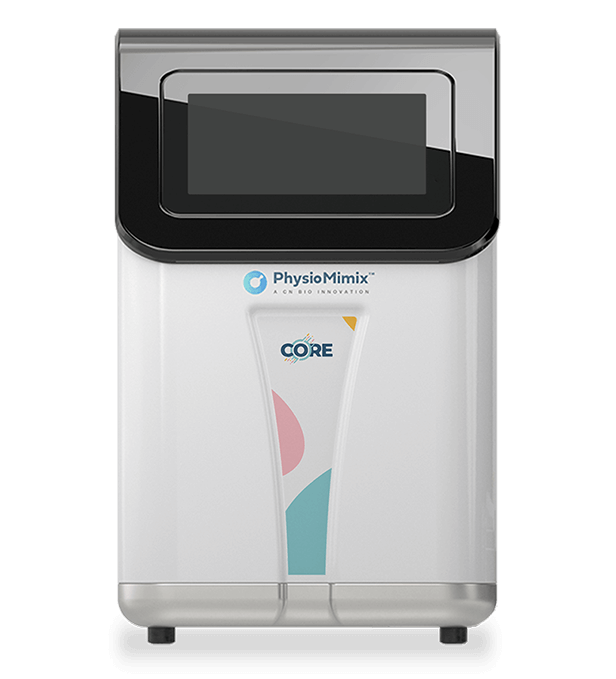
At the forefront of this innovation is CN Bio’s range of PhysioMimix Core Systems and solutions. It allows scientists to recapitulate the complexity of human organs by leveraging 3D tissue cultures of primary human cells. OOCs provide a physiologically relevant environment, where drug responses can be studies with unprecedented accuracy. Unlike conventional 2D cell culture models, these chips incorporate fluid perfusion, to mimic blood flow, allowing scientists to observe drug absorption, metabolism, and interactions across multiple organ systems—all within a laboratory setting.
Transform the Drug Development Pipeline
One of the greatest benefits of OOC technology is its potential to de-risk drug development. Late-stage clinical failures are costly, both in terms of financial investment and patient safety. By adopting OOCs into the early drug development pipeline, pharmaceutical companies can obtain high-quality, human-relevant data long before clinical trials begin. These insights help scientists make informed decisions about which drug candidates to progress, reducing the likelihood of failure in the clinic.
Regulatory bodies are also recognising the value of alternative testing methods. In the U.S., the FDA Modernization Act 2.0 and the recently passed 3.0 version are driving the adoption of new alternative methodologies (NAMs), including OOCs, to refine drug evaluation processes. As confidence in these models grows, their role in regulatory submissions is expected to expand as well, paving the way for safer, more effective drug development strategies.
Addressing Key Areas of Drug Failure
OOC is particularly beneficial in tackling the primary causes of drug attrition – poor bioavailability, unforeseen toxicity, and lack of efficacy. It provides valuable insights into how a drug is processed by the human body, from absorption in the gut to metabolism in the liver, allowing researchers to fine-tune formulations before entering costly in vivo and first-in-human studies.
For example, metabolic dysfunction-associated steatotic liver disease (MASLD) and its severe form, metabolic dysfunction-associated steatohepatitis (MASH), affect millions of people globally. Traditional animal models struggle to accurately mimic human metabolic pathways, leading to misleading data. OOCs overcome this limitation by using human-relevant models, offering better predictions of drug efficacy and toxicity.
Toxicity is another major hurdle in drug development, accounting for up to 30% of failures. OOCs provide a detailed, mechanistic view of how a drug interacts with human tissues, enabling scientists to detect potential toxic effects earlier. This not only improves drug safety but also allows scientists to refine in vivo study design, reducing the number of animal studies needed.
Beyond Traditional Drug Testing
The versatility of OOC technology extends beyond small-molecule drugs. With the rise of new modality drugs, such as RNA therapeutics, gene therapies, oligonucleotide-based treatments and cell-based medications, scientists require models that better capture human biology. Many of these new modality compounds target mechanisms unique to humans, making traditional animal testing less effective. OOCs offer an ethical and scientifically superior alternative, accelerating the development of these advanced treatments.
The Future of Organ-on-a-Chip Technology
As the pharmaceutical industry embraces innovation, OOC technology is poised to become an essential part of drug discovery and development. With further advancements, OOCs will continue to gain traction, offering a faster, more reliable, and cost-effective pathway to developing new medicines.
This article was originally published in European Biopharmaceutical Review Magazine, Winter 2025 edition. EBR shares insights from Sung Lee, Director of Product Development at CN Bio, on how OOC is transforming drug development and discovery efficiency in areas where drugs most frequently fail – efficacy, toxicology, absorption, distribution, metabolism and excretion.
Read the full interview here.
References
1. Sun, D., et. al., (2022), Why 90% of clinical drug development fails and how to improve it?
4. Musther. H., et. al., (2014) Animal versus human oral drug bioavailability: do they correlate?