




Resource > Webinars >
Building better data packages: The role of MPS in modern efficacy, toxicity and ADME workflows
Technology Network: Organoids and Microphysiological Systems Symposium 2026
Filed under: ADME, DILI, Disease modeling, General OOC, MASLD/MASH, Regulatory, and Safety toxicology
Video content if present
Explores how microphysiological systems (MPS) can be integrated into modern drug discovery workflows to generate more predictive, human‑relevant data. Drawing on real-world case studies in metabolic liver disease (MASLD/MASH) and drug‑induced liver injury (DILI), the talk shows how validated liver MPS models can bridge gaps between traditional in vitro assays, animal studies, and the clinic to support better‑informed decisions across efficacy, safety, ADME and regulatory submissions.
Key Learning on how to build better data packages using MPS:
- How MPS improves translational confidence by closely mimicking human biology
- Why MPS are most powerful when integrated into workflows alongside other in vitro, in vivo and in silico tools
- How validated MPS data directly informs development decisions
Q&A
Webinar Transcript
00:00:03: Hi, I’m Amina Jamil, conference and webinar producer at Technology Networks, and I’m here to introduce our next talk from our Technology Spotlight sponsor, CN Bio.
00:00:13: I am pleased to welcome Dr. Tomasz Kozczewski, presenting his talk, Building Better Data Packages, the Role of MPS in Modern Efficacy, Toxicity, and ADME Workflows.
Tom Koschewski is Chief Scientific Officer at CN Bio with more than 15 years of experience leading scientific research in the fields of molecular biology, immunology, and tissue engineering. He is responsible for scientific and technical strategy at CN Bio, where he oversees the team of biologists, engineers, and data scientists to design, develop, and validate a range of microfluidic bioengineered platforms for the culture of miniature human organs for use in preclinical drug development.
He joined CN Bio in 2015, and was promoted to Director of Biology in 2018, VP of Science and Technology in 2021, and to CSO in 2023.
He has a PhD in Molecular Immunology from Imperial College London and has previous experience working within academia and large pharma developing biopharmaceutical therapeutics.
A warm welcome to you, Tom.
Following the presentation, we will also have a Q&A session, and we welcome any questions that you may have. Please ask questions using the Q&A system to the right-hand side of the video player.
Without further ado, I will now hand over to Tom to begin his presentation.
Development of new drug poses a range of challenges
00:01:39: Hi everyone, thanks for the intro.
So yeah, I’m going to present to you today some of the work we’ve been doing at CN Bio to build the next generation of microphysiological systems (MPS).
I’m sure we’re all aware, developing new drugs is a real challenging activity. And it’s becoming ever more complicated as the years go by with the rise of ever broader range of different modalities of drugs, the rise of AI and AI design drugs, and also a broader need to reduce the number of animal testing.
00:02:10
So, if we’re really going to bring drugs to market more efficiently, more effectively, more cost effectively, we really need to build preclinical models that are human focused. They really capture the complexities of human disease and toxicity. They’re appropriate for all these new modalities that are being developed, but they’re also usable and scalable for users in pharma and biotech.
The pre-clinical toolbox
00:02:34:The pre-clinical toolbox today is actually now getting ever broader.It contains traditional models, so traditional in vitro, 2D biological models, in vivo models, and a whole range of new approach methodologies, NAMs. And microphysiological systems is just one of these.And we really believe at CN Bio that using the right tool for the right question is key and that all of these tools should be used to complement each other to create the appropriate workflows to really generate the ultimately the best data packages to progress molecules effectively to the clinic.
Global regulatory shifts towards NAMs
00:03:09: NAMs have really grown in traction over the years.I’ve been working in this space a long time, as you’ve heard, and it’s been really pleasing to see how over the last couple of years, the regulators, globally, have really taken notice of the need for these tools and to reduce and refine the way that we use animals appropriately.
So, this is not to exclude animals, but to promote the use of these NAM-based technologies as part of regulatory filings to ultimately make effective decisions about which molecules to take forward.
I’m sure many of you are aware of these changes globally.
MPS can model many human organs for a wide variety of applications
00:03:44: So, more specifically, microphysiological systems come in all sorts of shapes and sizes, and they’ve now been developed to model all sorts of different tissue types, cells, and organ models of the human body. The key features are that they typically contain human cells – these can be from primary or stem cell sources. They’re there to mimic the microenvironment of the human tissue that they’re trying to model.
Then, they can be utilized in a number of ways. They can be utilized to measure toxicity effects, ADME, DMPK effects of drug dosing, pharmacology, and also model human disease. Potentially one future looking aspect is one day they might be used to really look at personalized medicine.
PhysioMimix® MPS technology
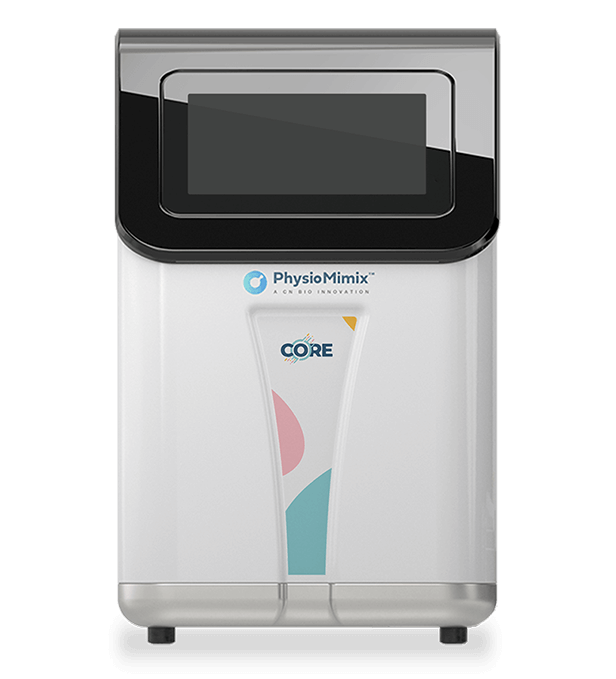
00:04:27: At CN Bio, we’ve developed the PhysioMimix platform. This platform’s been available now for almost a decade. And it’s a relatively unique MPS platform – it has multi-well / multi-chip plates.
So, each of these is an open well plate. It contains a number of chips within it. And these are specifically designed for different applications and for different tissue models. And we have a range of different tissue models. It’s a real, very, very easy, straightforward system to set up.
What’s important is that we also work to develop and validate the optimal cell sources to go into any of these chips to develop our tissue models.
Today I’m just going to give you an overview about how we use these and how we incorporate this technology alongside other workflows to generate the best data packages we can in drug development.
PhysioMimix Liver MPS mimics human biology
00:05:14: So let’s dig a little bit deeper about how some of these plates work. Today I’m going to focus on our liver NPS platform.
What we do is we take primary human cells of the liver, we take hepatocytes and all the non-parenchymal cells of the liver, we seed them in to our liver chips to form three-dimensional microtissues, and they form within the scaffolds within our chips, and they form these beautiful three-dimensional microtissues you see on the left-hand side.
Functionally, these are incredibly metabolically active. They’re very stable. We culture these for a number of weeks, even months. They express all the right biomarkers of the human liver.
On a transcriptional basis, the transcriptional profile of the bulk tissue here really represents a human microtissue and mirrors very closely the liver biopsy.
PhysioMimix MPS applications
00:06:05: And we can use our MPS technologies for a wide variety of applications.
We’ve built a number of different disease models, ADME and DMPK models, and safety toxicology models. And I’m going to highlight a couple of these for you today.
Translation in drug development workflows
00:06:18: And as I say, these have to be used as part of a workflow.
They have to be used to take drugs from that early stage of screening, once you’ve identified a target, through lead optimization, through preclinical modeling, and potentially even to complement and enhance how drugs are taken through clinical trials.And we have a number of examples where we’ve done that.
And what’s important is asking, using the right model at the right time as you go through this drug development pathway and really looking to combine the data from different platforms to really get the effective understanding of, well, is my drug going to be safe and is it going to be effective?
MASLD and MASH
00:06:56: The first example I’m going to show you is how we’ve modelled metabolic liver disease, also referred to as MASLD or MASH. This is where a healthy liver accumulates fat over time in obese and overweight patients, often associated with diabetes. Then as it gets more significant, it goes from MASLD into MASH. And here we have inflammation and scarring of the liver and eventually this becomes irreversible and the patient will have liver cirrhosis, liver failure, potentially liver cancer.
There is only one real marketed drug for this treatment currently. It’s not particularly effective and therefore actually there is a real need to find alternative therapeutics for it.
PhysioMimix MASH assay
00:07:42: So, we asked a question a number of years ago, could we model this in our system? And we’re now able to do this very effectively. So, we take our liver MPS platform with its three-dimensional scaffold. We take primary human liver cells and we pre-screen these, we identify these, we look for key characteristics such as insulin sensitivity. We look for any particular genetic markers that might be of interest. And we combine these with Kupfer cells and hepatic stellate cells that really drive this disease. We then combine it with a very specific media, which contains dietary fats and sugars. And we culture this then for a number of weeks. And over that period of time, the MASLD and MASH phenotype really takes hold inside these liver microtissues.
Even just from the microscope image I show here of one of our microtissues, you can see in the dark red, the presence of fat and the cells actually accumulating fat in these microtissues. And in the pink here, you see some of the fibrotic markers coming up during the late stage of the disease.
What’s important, and this goes for all of the models we develop, is having translationally clinically relevant readouts. So, we measure all the things that you would see with patients with this disease in the clinic. We can measure the fat loading, the steatosis already mentioned. We measure the inflammation, the fibrosis, metabolic changes in the liver, and the overall liver health and functionality. We can use this then as a screening tool to look at how therapeutics can be used to intervene with the development of this disease.
Modeling MASH
00:09:11:So looking at this a little bit more detail, as we load these liver microtissues in our MPS with fat, we can see that fat accumulate over time. We have lean media controls as well. As I mentioned, we have a full inflammatory milieu that occurs in our chips as a result of the fat and sugar loading in these chips. In particular, key biomarkers such as IL-6 and MCP-1 are all very abundantly expressed in the milieu from these chips as a result of the disease state that we’re generating. Again, this evolves over time.
Most fundamentally, most importantly, we have a very strong and robust fibrotic phenotype in the later stages of this disease.
And we can measure this both from the soluble markers, such as TIMP-1 but also through an imaging approach, we can look at those micro tissues. We stain for the presence of collagen and alpha smooth methyl-actin. And we see very clearly the presence of these being laid down in these 3D micro tissues.
We can quantify this and use it as a really key endpoint for interventions looking to reduce fibrosis.
Modeling MASH – Transcriptomics profile comparison
00:10:18: Again, at a transcriptomic level, if you take the bulk transcript from these micro tissues, put it into an atlas, it really looks like it’s looking at a human biopsy of this disease. We have a very, very close overlay of the specific genes that change in the disease in these liver microtissues in our MPS, as opposed to a human F1, F2 patient – much more closely representative than with the most advanced murine models. And you see this both on the right hand side, the Venn diagram, but also the graphic at the bottom here, where the key genes that change in the disease, the key pathways, metabolic pathways that change, are really not represented in key murine models of disease, but they are all abundantly expressed in our in our MPS model.
Profiling efficacy of anti-MASH drugs
00:11:01: Then, we can probe it with a variety of different compounds. A number of these are in late stage clinical development and they have a variety of effects and we can compare and contrast how these different molecules affect different endpoints.
Some of them can drive more anti-inflammatory phenotypes and some have more pro or anti-fibrotic responses and we can screen these and we can compare and contrast and we can quantify all of this data very, very effectively across lots of our microtissues to get really clear data and accurately tease apart dosing responses. And importantly, you know, we mimic the PBPK of the drugs that we dose in our chips to closely mimic those that are used clinically or potentially in in vivo models to make sure we’re representing the appropriate dose and efficacy.
Advancing MASH candidates to the clinic
00:11:50: To show you an example of how far we’ve taken this, well, we worked with a company called IniPharm, a US biotech, who were developing a small molecule inhibitor against a target – HSD17B13. They were wanting to get into the clinic as quickly as possible. They were having challenges because this target is poorly expressed in vivo models.
INI-678: Effect on fibrosis, inflammation and steatosis
00:12:10: We worked with the IniPharm team over a period of time. We identified that their molecules against this particular target were effective; they could reduce this fibrotic phenotype.
They also had effects against inflammation and steatosis, as you see from the data in this slide. And we iterated with the IniPharm team.
INI-822: Selecting a lead candidate
00:12:30: We looked at a number of different compounds in their set and identified a lead compound for them. This data correlated very nicely with other in vivo data that they generated to really give them confidence that INI-822 was their lead candidate.
It wasn’t toxic, didn’t cause any damage to the liver as you see on the graph on the left, but it had a very robust and consistent fibrotic phenotype as well as changing a number of other metabolic markers.
Advancing MASH candidates to the clinic
00:12:57: What this enabled Inipharm to do was to take this molecule into clinical development. And the data that was generated was a key part of the regulatory filing. And this molecule is now progressing nicely in the clinic. And you can go and read about that.
Translation in drug development workflows
00:13:17: So to give you a second example, so that’s on there, I’ve just shown you an example of efficacy to say to change track, I’m going to also show you how we use an RMPS for also evaluating safety and off-target effects, [which are] just as important for developing therapeutics.
Drug-induced injury workflow
00:13:35: Drug-induced liver injury or DILI is still a major issue for developing drugs, particularly as more complex drugs are being developed. DILI from the graphic on this slide, appears in many different ways in human tissues. And it’s important to try and recapitulate all of these.
And typical screening for DILI is shown in the slide here. So, they typically start with in silico or very high throughput, simple in vitro screens and then these typically go to in vivo before you go into the clinic. And this has caused some challenges. And so using MPS chips through late stage optimization and through preclinical could be really effective because we can really capture all of these key clinical readouts for drug-induced liver injury to de-risk molecules as they move towards the clinic and complement and supplement those more traditional ways of understanding these responses.
And importantly, if signals are also seen in the clinic, our technology can be used to supplement and pick apart the issues that might be seen clinically.
Human DILI assay – screening and investigative toxicology
00:14:41: So, how does our DILI screening assay work? Well, again, we take one of our liver [plates], either our Liver-12 or our liver-48, we seed in hepatocytes and immune cells of the liver – Kupffer cells. Then we start dosing these typically after a few days once the microtissues have formed up. And then we can continually dose again at an appropriately relevant concentration. We continue to do this either for a week or maybe for a number of weeks, depending on the dosing regime we want to try and mimic. And then we have a broad range of different endpoints to assess both the functionality of the liver and the health of the liver. And particularly measuring those clinically relevant biomarkers, things like ALT and AST release. We can look at cytokines, we can look at bile acids to look at cholestatic effects. We combine all of this data together to really get an understanding of what a molecule might be doing in a patient’s liver.
Human DILI assay – screening and investigative toxicology
00:15:34: Just to show you some examples, so we have this longitudinal testing. You see an example of a drug here at the top where it has a very clear ALT spike, as a result of a drug dose, and then that rapidly causes the albumin to reduce over time. Because of the throughput of our platform, we’re very easily able to generate EC50 curves and compare pairs of compounds or sets of compounds. And you see the example here for troglitazone and pioglitazone, a classical pair of a very toxic molecule in troglitazone and it’s slight and it’s less toxic derivative, pioglitazone. And then more than that, we can take these drugs and really delve deeper into their mechanistic profiles of really how are they causing this toxicity. And whether that’s through transcriptomics, through detailed high content imaging, or as I say, looking at bioacid responses, as you see on the graph on the right hand side. We take all of this data together to give a really good understanding for a researcher of how risky this molecule is going to be to take forward.
PhysioMimix DILI assay qualification
00:16:38: We’ve qualified this assay or validated this assay in a really broad and deep way. So, one thing that we did a couple of years ago was take a broad set of compounds published by the IQMPS consortium, and pretty much all of these have been screened through our platform now. When we rank all these molecules from the highest DILI concern to the lowest, across a range of different endpoints from the platform, we rank them very accurately from the least toxic to the most toxic, when we take the data from our platform and looking at the EC50 relative to C-max.
PhysioMimix enhances safety studies
00:17:13: This technology can therefore be used in a number of different ways. It can clearly be used to inform decisions in the way that these molecules are taken forward as you go through development and really kind of avoid delays once you get into those late stage preclinical studies.
They can obviously be used to support investigative topped work, when signals are seen in the clinic. But they can also help with species cross-reactivity and translation because we can also run all of these assays with preclinical animal species. We can run rat, dog and NHP cells in this MPS assay. I’m not going to show you that data today, but you can certainly find that through the CN Bio website.
3RsC-FDA DILI Project
00:18:01: To show you just a little bit more about how we’ve been using this technology, we’re working with a cross-party consortium evaluating DILI assays.This has been led by the FDA through the Center of Drug Evaluation Research (CDER) and the 3Rs Collaborative. This work’s been submitted and accepted onto the FDA’s ISTAND programme.
What we did with this consortium, there were eight different technology providers, each were given 8 blinded DILI compounds.
CN Bio DILI assay results
00:18:29: I can show you very briefly what we were able to do was to take these, we exposed them in our MPS chips for 10 days, broad range of concentrations. They were blinded. We didn’t actually know the concentrations, but we just knew that they were relative to C-max. And they’re mainly below, but just also slightly above C-max. And we assessed a wide range of endpoints. We were really pleased to see that we could clearly identify four toxic compounds and four negative clean compounds. Once these compounds were unblinded, we were able to see this is was exactly what was expected and we were really pleased. But more importantly than that, again, we were able to get mechanistic insights.
So here’s an example for one of the drugs where we were able to really specifically see the cholestatic effect for that drug as the concentrations of it increased.
Just to show you some deeper examples, here we have two drugs, a toxic and again a non-toxic pair of levofloxacin and trovafloxacin, where the levofloxacin data is clearly non-toxic – we don’t see any significant rises in ALT, and the albumin is pretty stable across the culture but for trovafloxacin, we see very strong ALT responses, and the albumin is definitely affected as these cultures continued over time.
PhysioMimix DILI assay – decision making
00:19:46: And finally, just to put this into the real world context of how do these data sets allow real world decision making?
Well, a couple of case studies for you. So we’ve worked with a mid-sized US pharma. They had a compound that was identified to potentially have some DILI issues related to QSAR and some simple in vitro assays. We were able to identify for them very explicitly that their molecule at certain doses potentially had some DILI risk. But actually, by combining the data from our MPS with QST modelling, they were able to identify specific risk factors and mitigate their DILI issues and allow that molecule to go forward into the clinic.
For a second case study, we worked with a large pharma in the US and they again had a molecule with mixed data from in vitro and in vivo approaches and they employed the liver MPS here and they specifically identified that it did, they did have a compound with cholestatic injury risk. And what was decided was that they would stop the program.
We have a number of examples here where this liver MPS assay is used effectively to make decisions.
PhyioMimix enhances safety studies
00:20:50: So hopefully, I’ve shown you that we can use this liver MPS assay across the drug discovery workflow to inform decisions effectively by taking molecules forward through clinical development.
Conclusions
00:21:02: We can use it effectively both across efficacy and safety studies. These data sets can be incorporated into IND filings but importantly used alongside other assays to create really comprehensive data packages. What’s important is that we use this in a very context of use specific manner to demonstrate how these MPS are affected.
So, there’s a lot of people to acknowledge, but some of the key people, obviously we have a great team at CN Bio, some of our key partners, as I’ve highlighted Inipharm and that C-PATH, the 3RsC, and the group at the FDA.
Speaker

Dr Tomasz Kostrzewski
CSO
Prior to joining CN Bio, he worked at Imperial College London in the Department of Life Sciences studying immune cell development and stem cell differentiation, as well as at GlaxoSmithKline working in biopharmaceutical drug discovery and development. Dr Kostrzewski holds three degrees from the University of Sheffield and Imperial College London in Cell and Molecular Biology.