




• Skip to main content
  • Skip to footer
cnb1576_uk-reg-news_navigation-ad_v1
  • About us
  • News
  • Events
  • Careers
cn-bio-organ-on-a-chip-logo
  • Products
    • PhysioMimix® Core Microphysiological System
    • Consumables
      • PhysioMimix® Multi-chip plates
      • 3D validated cells
      • NASH-in-a-box
    • Organ-on-a-chip models
    • Gut/Liver-on-a-chip
    • Lung-on-a-chip
    • Support packages
  • Applications
    • Disease modeling
    • Safety toxicology
    • ADME
  • Services
    • Non-Alcoholic Steatohepatitis
    • Drug-Induced Liver Injury
    • ADME
  • Technology
  • Resources
  • Company
    • About us
    • Events
    • News
    • Careers in Biotech
  • Contact us

Explore our solutions


PhysioMimix® is a suite of hardware, consumables and assay protocols that enable you to recreate complex human biology and accurately predict human drug responses.

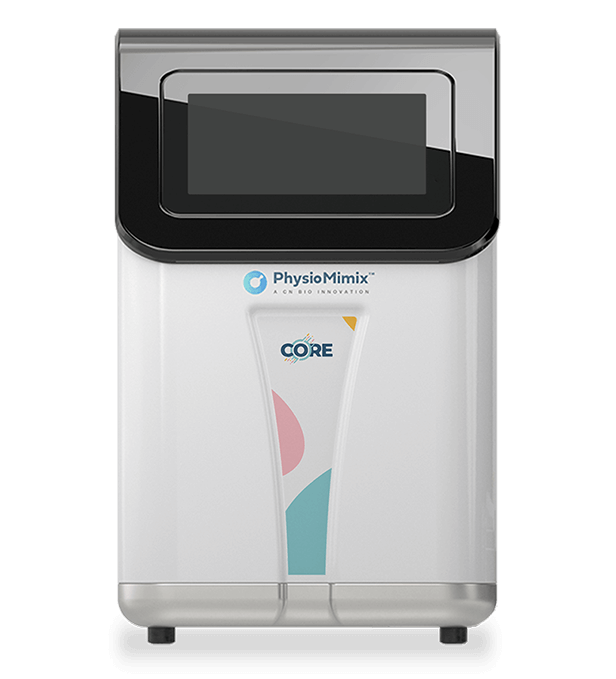
PhysioMimix Core

cnb1476_physiomimix-core_mark_mocks_system_v2
Learn more

Consumables

Multi-chip plates
3D validated cells
NASH-in-a-box
Learn more

Models

Single-organ models
- Liver-on-a-chip model
- Lung-on-a-chip model
Multi-organ models
- Gut/Liver-on-a-chip models

Support packages

PhysioMimix® support packages

Discover the applications


Investigate the validated core application areas that our PhysioMimix® products and services support

Learn more

Disease modeling

Metabolic dysfunction-associated steatohepatitis
Hepatitis B
Pulmonary infection
Learn more

Safety toxicology

Drug-induced liver injury
Immune-mediated liver injury
Learn more

ADME

Drug absorption
Drug metabolism
Drug bioavailability
Oligonucleotide delivery
Learn more

Studies as a service


Our team will work collaboratively with you to design a study around your research goals and generate actionable data within weeks

Learn more
icon-nash-1-150x150.png MASLD/MASH
icon-dili-tox-150x150.png Drug-induced liver injury
icon-adme-150x150.png ADME

Addressing Unmet DILI Challenges: Novel insights from adaptable Liver microphysiological systems

January 28, 2026

Event > Webinar >

Addressing Unmet DILI Challenges: Novel insights from adaptable Liver microphysiological systems


Discover how Liver MPS address unmet DILI challenges – from cross‑species comparisons to evaluating cholestatic and complex mechanistic risks. Explore how MPS strengthen toxicology workflows, reduce translational risk, and improve confidence in human safety outcomes.

cnb1372 emily webinar v2 | unmet DILI Challenges
03 March 2026
08:00 (LA)| 10:00 (NY)| 15:00 (UK)
Virtual
Register here

Drug-induced liver injury (DILI) remains a major challenge in drug development, especially when traditional models fail to capture complex or species-specific risks. Addressing these unmet workflow limitations is essential for improving confidence in drug safety assessment, particularly for multifaceted liabilities such as DILI.

In this webinar, we will demonstrates how Liver microphysiological systems (MPS) can be adapted to investigate different areas of toxicology – from lead optimization screening to identifying and understanding species-specific risks, informing study design and supporting mechanistic investigations of adverse DILI events in humans.

Drawing on recent peer‑reviewed studies, we will present a case example showing how Liver MPS studies compare across human and preclinical animal species. We will also explore challenges in evaluating cholestatic drug effects that cause DILI. Using a side-by-side comparison of multiple Liver MPS configurations, we will highlight how biological fidelity varies across systems and what is required for robust and reliable mechanistic cholestasis research.

Attendees will gain insight into where MPS adds the most value for reducing translational risk and increasing confidence in human safety outcomes.

Key Learning on how Liver MPS are used to address unmet DILI challenges:

  • Understand the importance of using MPS for cross-species DILI comparisons
  • Learn how MPS enables more complex and latent DILI effects to be unlocked
  • Explore what’s required of an MPS to evaluate cholestatic drug effects
  • See how to adopt and adapt MPS for different areas of toxicology and safety testing

About the Presenter:

Emily USE THIS ONE | unmet DILI Challenges

Dr. Emily Richardson

Dr. Emily Richardson is driving development of MPS for toxicology and safety assessment. She led the development of CN Bio’s Lung and Lung/Liver models for infectious disease research and inhaled therapeutics, and spearheaded multiple other collaborative and grant-funded programmes, published peer-reviewed papers, and contributed to advancing regulatory acceptance of Organ-on-a-chip.

Her work bridges complex cell biology and real-world drug discovery, informed by a PhD from the University of Leicester in 3D cell culture for metastatic lung cancer and a BSc in Biochemistry and Molecular Medicine degree from the University of Nottingham.

Addressing Unmet DILI Challenges: Novel insights from adaptable Liver microphysiological systems

Register here

Speak to our experts

Request a meeting with one of our OOC experts to see how our products and services can support your studies

Request a meeting

Footer

CN Bio logo

332 Cambridge Science Park, Milton Road
Cambridge, CB4 0WN

UK: +44 (0) 1223 737 941

US: +1 415 523 4005

Privacy | Cookies | Regulatory | Accessibility
Website terms | Terms of sale

Product Recycling

©2025 CN Bio Innovations Ltd
Registered No. ‍06517359. VAT No. GB978184563

Latest news

  • CN Bio to participate in 3Rs Collaborative-led project with FDA to build confidence in Liver MPS for DILI – now ISTAND accepted! January 25, 2026
  • Taking organoids to the next level January 14, 2026
  • UK plans to phase out animal testing faster in favor of alternative methods November 11, 2025
Cyber Essentials Logo

Modal Title