




Resource > Case studies >
How LIST moved from static to fluidic organ-on-a-chip toxicology models to answer more complex questions
Filed under: General OOC, Regulatory, and Safety toxicology
Laboratories working at the intersection of toxicology and regulation, like the Environmental Health Group at Luxembourg Institute of Science and Technology (LIST), face a challenge to translate complex biological data into clear, usable outputs for hazard and risk assessment.
As research questions become more complex, simple in vitro models may no longer be sufficient. The choice of model needs to be guided by the specific research question so that it is fit for purpose.
For Dr Emma Arnesdotter, a toxicologist in LIST’s Environmental Health Group working primarily with environmental pollutants, that challenge became particularly tangible through LIST’s contribution to the TULI project, an ambitious research project supporting European food safety. The goal was to build a multi-omics pipeline capable of measuring complex biological responses (like transcriptomics, metabolomics, and DNA methylation) to chemicals with known toxicity. The ultimate aim is to translate these insights into a next-generation risk assessment tool that could inform regulatory decision-making.
There was just one problem. The static 3D models that Arnesdotter and her colleagues had been using were no longer suitable to generate the detailed data that was needed. This required a system that connected two different tissues together using more advanced, co-cultured barrier models of lung–liver and intestine–liver. A fluidic system was necessary to study the interaction between these organs.
“We had written a very ambitious project,” she explains. “But we had never worked with fluidic systems before.”
Emma Arnesdotter, PhD, ERT
Researcher, Sustain Unit, Environmental Health Group – Luxembourg Institute of Science and Technology (LIST)

Choosing a system for its usability
Many of the systems that the team considered required manual assembly, which would have introduced variability before experiments even began.
“It’s really like taking components out of sterile packaging and assembling them yourself,” Arnesdotter says. “That’s not user-friendly.”
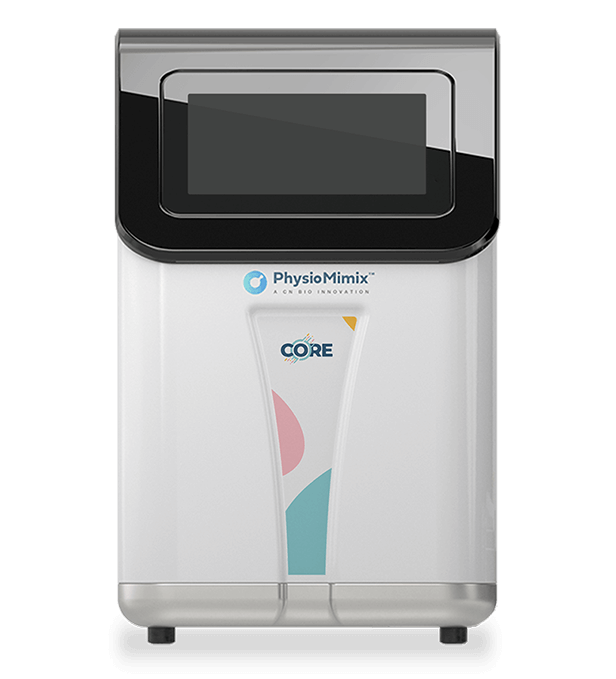
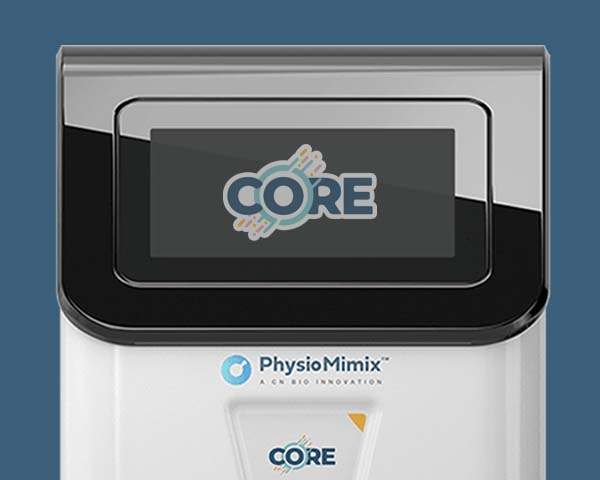
The breakthrough came unexpectedly when a colleague met another scientist who was using the PhysioMimix® System from CN Bio and they discussed what the team at LIST was hoping to do.
What stood out was just how user-friendly the system looked compared to what the team had been looking into.
“It’s an open plate system, which is what we have in our normal cell cultures. And you just pipette.”
The team was initially concerned about the higher upfront costs but soon realized that the ease of use saved time, and the cost of the time offset the investment. The decision was made.
Adapting the biology to fit the system
Arnesdotter’s team works primarily with cell lines. This required some changes to their existing models. For example, the lung model required redesign to sit at the air-liquid interface to maintain their physiological relevance. And for the liver model, CN Bio’s primary human hepatocytes were replaced with a cell line (HepaRG).
“I thought switching cell types would be easy,” she admits. “It wasn’t. But that was biology, not the system.”
The changes required rethinking the experimental design, but in the end, this aligned more closely with the lab’s ambition to move toward more applicable models.
Watch how to adapt models to meet your needs with PhysioMimix Core
Greater physiological relevance introduces complexity
Moving from static systems to fluidic co-cultures also introduced more complexity.
“The more complex you become, the more sensitive the system becomes,” Arnesdotter explains.
In practical terms, this meant increasing the number of replicates. Arnesdotter attributes the variability mainly to cell seeding. It is often difficult to control how many cells attach to the scaffold when pipetting them into the plate. While additional replicates have added to the costs, they are necessary for experimental robustness. She believes that this was not unique to the PhysioMimix platform.
“This is true for all fluidic systems,” she notes. “It’s the price of complexity.”
Talk to an expert about your toxicology model
Reliability under continuous use
While complexity may increase, reliability is critical. Over more than a year of near-continuous use, the system proved unexpectedly robust.
“It has been more reliable than I expected,” she says. “The machine itself has been extremely reliable.”
Issues that did arise were largely linked to consumables rather than the hardware. For a lab running experiments continuously, this matters, and it built confidence not only in outputs, but in the system itself.
Scaling up and looking ahead
With data generation underway and two years remaining in the EFSA project, the lab is already expanding capacity by purchasing a second system. The team isn’t looking to just increase throughput but also to do more exploratory work.
“We can really test the limits and do more fun stuff,” Arnesdotter says. The team is planning to test different tissue types and incorporate immune components in their tissue models.
Discovery how to scale up with PhysioMimix Core to meet today’s and tomorrow’s demands
Simplicity in a complex system
There’s a recurring theme that the conversation keeps returning to. Arnesdotter reflects, “It is a complex system that is very easy to use.”
The familiar open well plate format might have been the first thing that caught the team’s attention, but the modular design means it’s hard to make mistakes (for example, the driver goes into the docking station in only one way). The setup is also very quick.
Arnesdotter remarks, “You learn how to start a plate in half a day and there are not a lot of buttons to push. There’re not a lot of mistakes that can be made.”
So, training new users takes hours, not days. In a field where experimental systems often add layers of complexity, that simplicity is an advantage.
Watch to discover PhysioMimix Core’s easy-to-adopt workflow
Bridging the gap between science and regulation
The EFSA project aims to translate complex biological data into something regulators can use. The output is designed to provide a point of departure that will give a clear, interpretable endpoint derived from complex data and computational modelling.
“The problem is not just generating data,” Arnesdotter explains. “It’s making it understandable.”
In her experience, scientists and regulators often “talk past each other,” lacking a shared framework.
The project aims to change that.

Talk to an expert to discuss your model

Explore PhysioMimix Core in more detail

Safety toxicology applications