




• Skip to main content
  • Skip to footer
UK Plans to phase out animal testing cnb1662_ec-reg-news_navigation-ad_v2
  • About us
  • News
  • Events
  • Careers
cn-bio-organ-on-a-chip-logo
  • Applications
    • Disease modeling
    • Safety toxicology
    • ADME
  • Services
    • Non-Alcoholic Steatohepatitis
    • Drug-Induced Liver Injury
    • ADME
  • Products
    • PhysioMimix® Core Microphysiological System
    • Consumables
      • PhysioMimix® Multi-chip plates
    • Organ-on-a-chip models
    • Gut/Liver-on-a-chip
    • Lung-on-a-chip
    • Support packages
  • Technology
  • Resources
  • Company
    • About us
    • Events
    • News
    • Careers in Biotech
  • Contact us

Discover the applications


Investigate the validated core application areas that our PhysioMimix® products and services support

Learn more

Disease modeling

Metabolic dysfunction-associated steatohepatitis
Hepatitis B
Pulmonary infection
Learn more

Safety toxicology

Drug-induced liver injury
Immune-mediated liver injury
Learn more

ADME

Drug absorption
Drug metabolism
Drug bioavailability
Oligonucleotide delivery
Learn more

Studies as a service


Our team will work collaboratively with you to design a study around your research goals and generate actionable data within weeks

Learn more
icon-nash-1-150x150.png MASLD/MASH
icon-dili-tox-150x150.png Drug-induced liver injury
icon-adme-150x150.png ADME

Explore our solutions


PhysioMimix® is a suite of hardware, consumables and assay protocols that enable you to recreate complex human biology and accurately predict human drug responses.

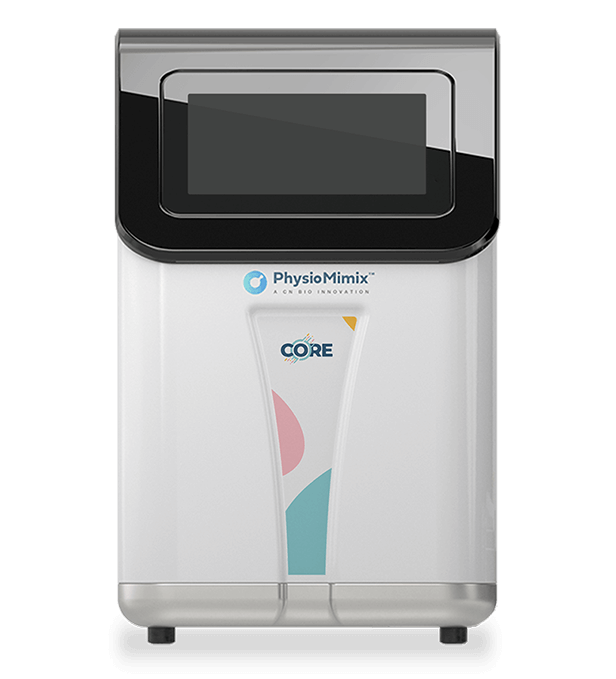
PhysioMimix Core

cnb1476_physiomimix-core_mark_mocks_system_v2
Learn more

Consumables

Multi-chip plates
Learn more

Models

Single-organ models
- Liver-on-a-chip model
- Lung-on-a-chip model
Multi-organ models
- Gut/Liver-on-a-chip models

Support packages

PhysioMimix® support packages

July 8, 2026

Resource > Posters >

Preclinical CAR T-Cell Testing: Evaluating Efficacy and Toxicity in a 3D Perfused Melanoma Model


Daniel Rieger, Yassen Abbas and Tomasz Kostrzewski

Filed under: Disease modeling and Oncology
cnb1683 development of a 3D perfused melanoma on a chip model poster mock v1 | melanoma-on-a-chip
View poster

Melanoma-on-a-chip model for evaluating CAR T cell efficacy and toxicity

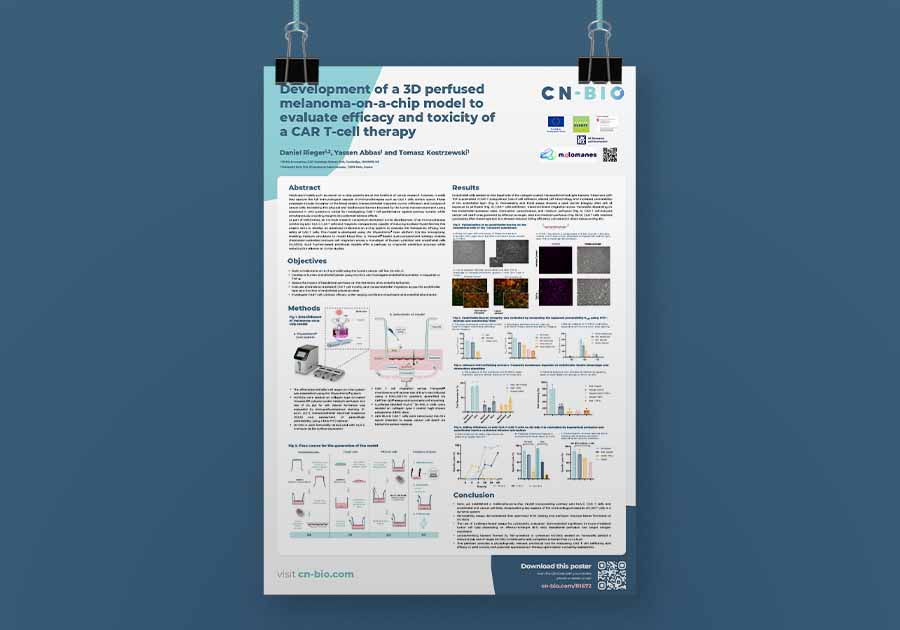
Researchers at CN Bio Innovations and Université Paris Cité have built a 3D perfused melanoma-on-a-chip model that measures how anti-HLA-G chimeric antigen receptor (CAR) T cells traffic to a solid tumor and kill it. Daniel Rieger, Yassen Abbas, and Tomasz Kostrzewski developed the model on the PhysioMimix® Core System, which circulates medium to model blood flow, using a Transwell-based dual-compartment design that separates the vascular side from the tumor side. The central finding is that CAR T cells retained their cytotoxicity after crossing an endothelial barrier but killed less efficiently than CAR T cells placed in direct contact with the tumor. Cancer cell death was governed by the effector-to-target (E:T) ratio, medium perfusion, and target antigen expression. Because a static co-culture removes the barrier before the experiment begins, that loss of potency in transit is invisible to conventional assays.

Human umbilical vein endothelial cells (HUVECs) were seeded on collagen type IV-coated Transwell membranes and cultured under perfusion at 0.5 µl/s for 48 hours. Barrier formation was tracked by immunofluorescence staining for F-actin and ZO-1, by transendothelial electrical resistance (TEER), and by paracellular permeability using 4 kDa FITC-dextran. Barrier integrity peaked after 48 hours of perfusion, and both perfusion and the collagen coating improved it. Treating the endothelium with tumor necrosis factor alpha (TNF-α) drove VCAM-1 upregulation, loss of cell adhesion, altered cell morphology, and increased permeability. SK-MEL-5 melanoma cells were lentivirally transduced to express HLA-G stably, and CAR T cell migration across 8 µm pore membranes was induced with a CXCL10/IP-10 gradient, with transmigration depending on endothelial activation state, chemokine concentration, and perfusion. The work forms part of Melomanes, an EU-wide consortium developing an immunotherapy that pairs anti-HLA-G CAR T cells with magnetic nanoparticles capable of inducing localized hyperthermia, and it gives developers a human preclinical tool for studying CAR T cell trafficking and efficacy in solid tumors alongside safety assessment.reducing the reliance on in vivo studies. 

Rieger D, Abbas Y, Kostrzewski T. Development of a 3D perfused melanoma-on-a-chip model to evaluate efficacy and toxicity of a CAR T-cell therapy. CN Bio Innovations and Université Paris Cité; Melomanes consortium.

View poster

Speak to our experts

Request a meeting with one of our OOC experts to see how our products and services can support your studies

Request a meeting

Footer

CN Bio logo

332 Cambridge Science Park, Milton Road
Cambridge, CB4 0WN

UK: +44 (0) 1223 737 941

US: +1 415 523 4005

Privacy | Cookies | Regulatory | Accessibility
Website terms | Terms of sale

Product Recycling

©2025 CN Bio Innovations Ltd
Registered No. ‍06517359. VAT No. GB978184563

Latest news

  • Organ-on-a-chip trends shaping the next phase of human-relevant R&D from the MPS World Summit 2026 July 6, 2026
  • Which microphysiological system contexts of use are aligned with regulatory roadmaps? June 2, 2026
  • A new era of drug development: Comparing regulatory roadmaps to reduce animal testing June 2, 2026
Cyber Essentials Logo

Modal Title