




Resource > Articles >
Designing organ-on-a-chip studies that stand up to regulatory scrutiny
Filed under: General OOC and Regulatory
Preclinical testing requirements are evolving. The FDA published its roadmap for reducing animal testing in preclinical safety studies in April 2025. The UK government followed with its Replacing animals in science strategy in November 2025, and the European Commission set out its roadmap towards regulatory acceptance of new approach methodologies in June 2026. All three point the same way. Human-relevant methods are expected to carry more of the preclinical evidence burden, and Organ-on-a-chip (OOC) systems, also known as microphysiological systems, sit close to the center of that shift.
For the scientists running these assays, the open question is whether a particular study was designed to produce data a reviewer can act on. That is where most of the practical difficulty sits, and it is what shapes how we build assays and services at CN Bio.
OOC assays are not complicated 2D cell culture
One of the most common misconceptions, says Tomasz Kostrzewski, PhD, CN Bio’s Chief Scientific Officer, is that OOC assays are “simply more complex versions of 2D” cell culture. Traditional 2D screens work with broad concentration ranges, short exposures of single cell types, and limited readouts such as viability, LDH release, or one biomarker. Run an OOC study to that template and the scope narrows to the point where regulators can reasonably call the dataset insufficient.
OOC models recreate organ-level function instead: barrier integrity in the intestine, metabolic activity in the liver, electrophysiology in the heart and at the neuromuscular junction, and hormone secretion in the pancreas. They hold under perfusion for weeks or months, with microfluidics supplying the nutrients, oxygen, and biomechanical cues that static culture cannot.
Study design should follow the logic of an animal study rather than a plate-based screen. That means a defined hypothesis and mechanistic question, sampling across a time course rather than at a single point, and a stated rationale for both endpoint selection and statistical powering.
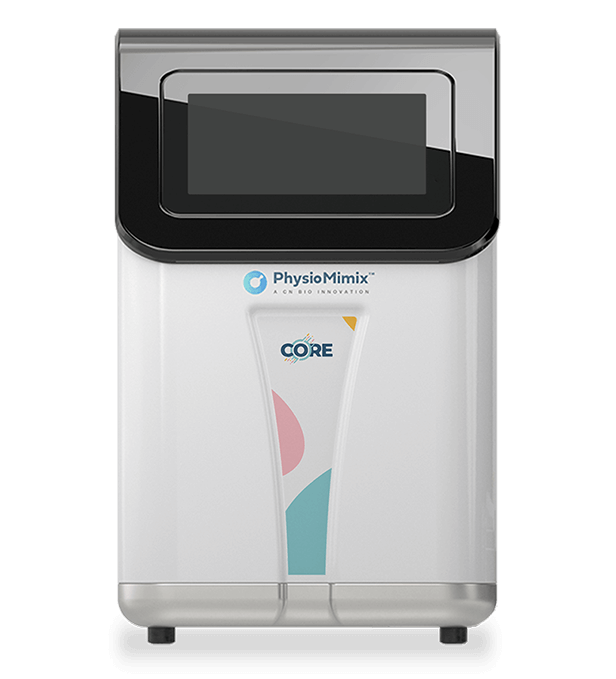
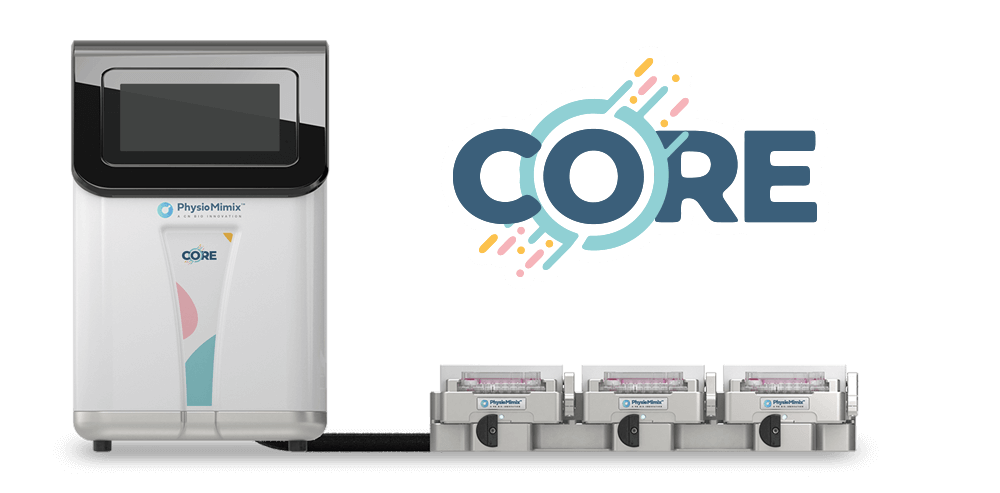
Learn more about the PhysioMimix® Core system and the models it supports
What the tissue is actually exposed to
Nominal drug concentration in the medium is not enough for a regulatory submission. Perfusion, microfluidics, and, in multi-organ configurations, organ-to-organ communication all influence how a compound distributes and is taken up. The question a reviewer will ask is what exposure the tissue experienced over time, and whether clinically relevant Cmax, AUC, or steady-state levels were reached during the assay. Large recoverable sample volumes make that answerable, since media can be sampled longitudinally and analyzed by LC-MS across the full-time course.
Establishing PK/PD relationships is what turns a result into an explanation. It shows a regulator both what the drug did and why it did it. Animal models are constrained here by species differences in transporter expression and metabolic enzyme function, which alter rates of absorption, metabolism, and excretion.
Learn more about human-relevant ADME profiling with PhysioMimix
Choosing endpoints a regulator can use
The range of signals an OOC assay can capture is one of its real strengths, and it is also where studies come unstuck. Too narrow and the data says little; too broad and it becomes hard to interpret. Four categories of readout are usually worth considering: cell health markers such as LDH and ATP, soluble biomarkers such as cytokines and hormones, functional tissue measurements such as cilia beat frequency and barrier integrity, and molecular responses including transcriptomics and proteomics.
Which of those to use follows from the biological question and the context of use. In hepatotoxicity work, combining albumin secretion, transcriptomic changes, and bile acid secretion builds a multidimensional picture of whether a compound caused cholestatic liver injury, that a single viability readout cannot.
Assay data also becomes more useful alongside computational approaches, including physiologically based pharmacokinetic (PBPK) models, machine learning classifiers, and computational toxicology frameworks. Combining multi-endpoint data from one assay, or data from several OOC models, helps bridge in vitro findings and predicted human responses and gives reviewers a coherent account of how the datasets fit together. Modeling can also expose discrepancies between animal and human biology, which strengthens the scientific justification for prioritizing the OOC study. We added in silico tools to our ADME contract research services in September 2025 for exactly this reason.

On-demand webinar: Building confidence for regulatory decision making with immune-competent liver models
Dr. Emily Richardson and Dr. Justina Then explore emerging immune-competent models designed to predict immune-mediated toxicity for newer therapies – Coming soon on demand
Where OOC data makes the strongest case
The clearest impact so far has been on modalities whose targets exist only on human cells, among them peptides, oligonucleotides, and gene therapies. An animal model cannot capture the true response of a molecule that binds a receptor the animal does not have. Models built from primary human cells retain the surface proteins, transporters, and intracellular machinery needed to generate accurate pharmacology for these compounds, which puts them in a strong position for regulatory-submitted studies.
The FDA roadmap reflects that reasoning as its initial focus is highly human-specific monoclonal antibody therapies, where safety findings often trace back to cross-reactivity with human immune cells.
Standardization is the next hurdle
As OOC assays enter regulatory workflows alongside animal studies, attention turns to consistency. Agencies will expect evidence of assay-to-assay reproducibility, defined acceptance criteria, documented system qualification, characterization of baseline organ model function, and stability of that model over the course of an experiment. Without those fundamentals, even a sophisticated assay will not survive review. Consistent SOPs, qualification frameworks, and version control will matter as much as the biology as the field matures.
This is work CN Bio has been doing openly. Reproducibility data for our Liver-on-a-chip model was co-published with the FDA, the first peer-reviewed paper of its kind between a commercial MPS provider and a regulator. In January 2026, the 3Rs Collaborative-led project we are part of, which tests known hepatotoxicants across nine commercially available liver MPS platforms, was accepted into the FDA’s ISTAND program.
What this means for drug developers
Hybrid packages look like the near-term norm, with animal data combined with OOC and other NAM data to build mechanistically informed submissions. The commercial argument has been on the table for a while: Franzen et al. estimated in 2019 that OOC technology could reduce pharmaceutical R&D costs by as much as 26%. Regulators have said they will accept OOC and NAM data where the assays are fit for purpose and held to the same standards as in vivo work.
The practical implication is unglamorous. The infrastructure, skills, and partnerships needed to run OOC assays at the standard regulators expect take time to assemble, and the agencies have already been fairly specific about what they want to see.
Contract research services
Discover how to utilize our cross-species models to inform next-step decision making via our DILI in vitro Contract Research Services here.
Read the full column
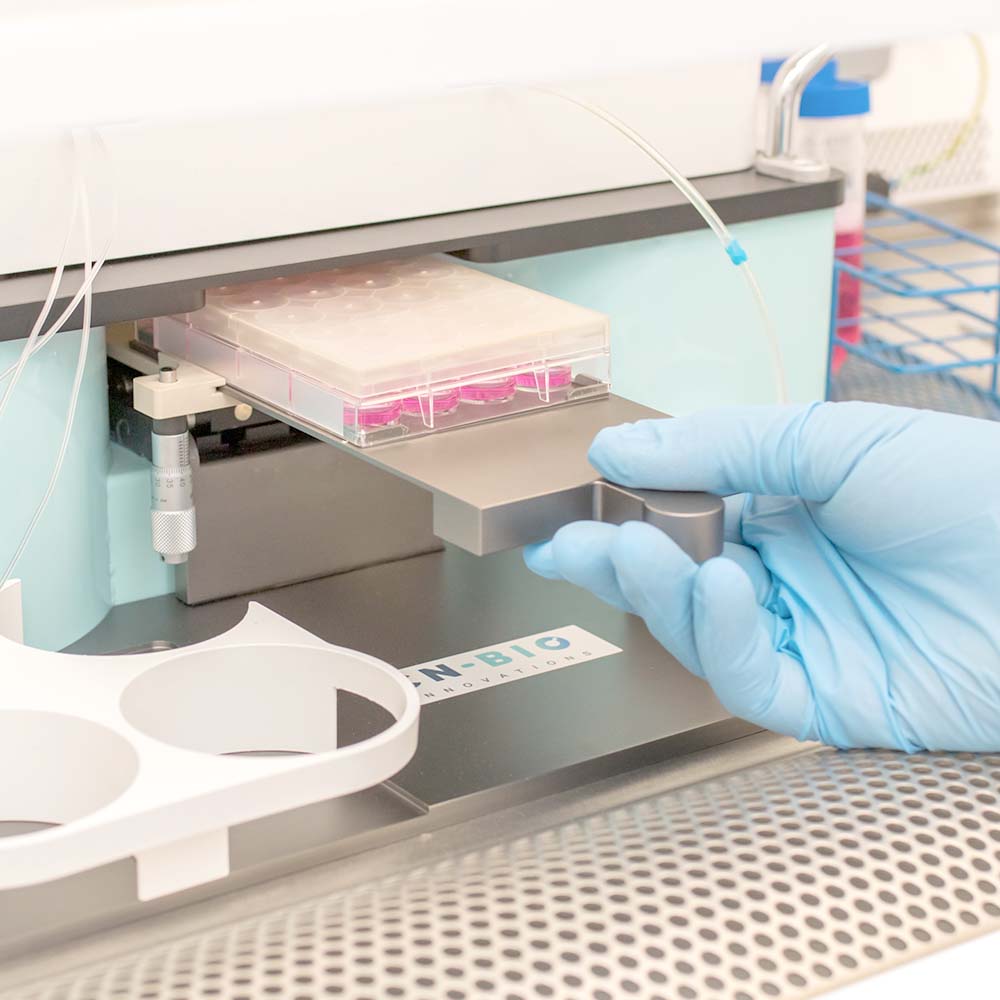
Tomasz Kostrzewski’s column sets out the considerations in more depth, including endpoint selection, exposure characterization, and what standardization will require as OOC assays move further into regulatory submissions. Read the full article in BioTechniques.
Originally published in BioTechniques, 21 July 2026.

Why the FDA animal testing phase-out for monoclonal antibodies? – Read the full Blog
UK plans to phase out animal testing faster in favor of alternative methods – Read the Full Blog

Dr. Tomasz Kostrzewski
Chief Scientific Officer
Prior to joining CN Bio, he worked at Imperial College London in the Department of Life Sciences studying immune cell development and stem cell differentiation, as well as at GlaxoSmithKline working in biopharmaceutical drug discovery and development. Dr Kostrzewski holds three degrees from the University of Sheffield and Imperial College London in Cell and Molecular Biology.