




Resource > Posters >
Preclinical CAR T-Cell Testing: Evaluating Efficacy and Toxicity in a 3D Perfused Melanoma Model
Daniel Rieger, Yassen Abbas and Tomasz Kostrzewski
Filed under: Disease modeling and Oncology
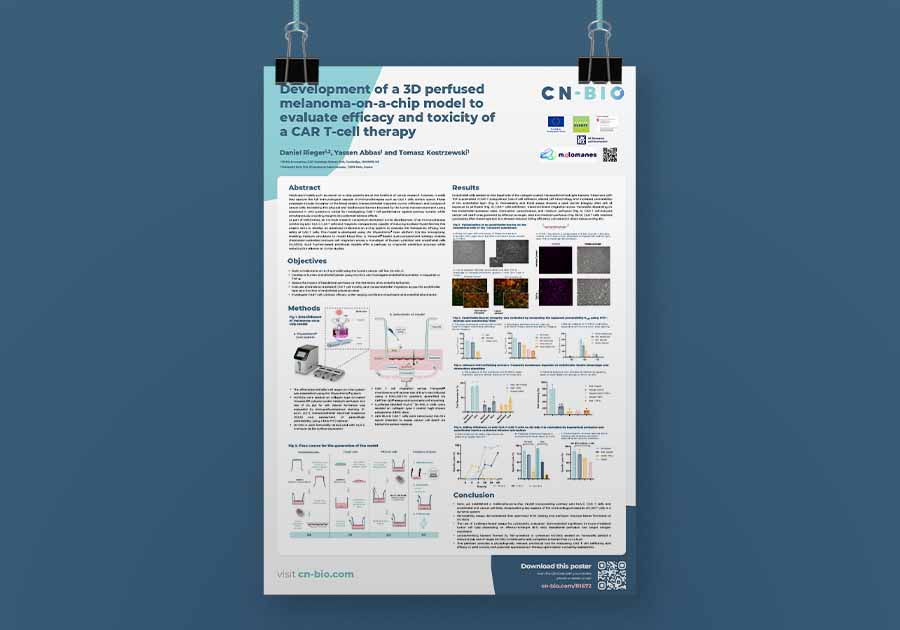
Melanoma-on-a-chip model for evaluating CAR T cell efficacy and toxicity
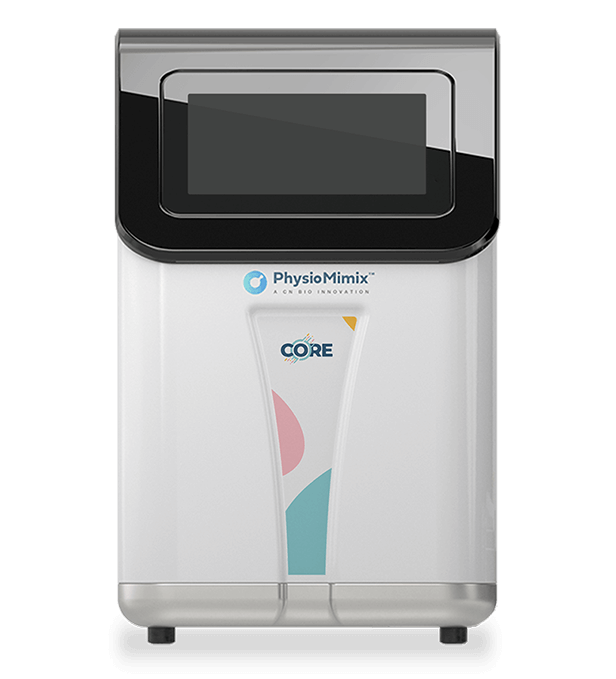
Researchers at CN Bio Innovations and Université Paris Cité have built a 3D perfused melanoma-on-a-chip model that measures how anti-HLA-G chimeric antigen receptor (CAR) T cells traffic to a solid tumor and kill it. Daniel Rieger, Yassen Abbas, and Tomasz Kostrzewski developed the model on the PhysioMimix® Core System, which circulates medium to model blood flow, using a Transwell-based dual-compartment design that separates the vascular side from the tumor side. The central finding is that CAR T cells retained their cytotoxicity after crossing an endothelial barrier but killed less efficiently than CAR T cells placed in direct contact with the tumor. Cancer cell death was governed by the effector-to-target (E:T) ratio, medium perfusion, and target antigen expression. Because a static co-culture removes the barrier before the experiment begins, that loss of potency in transit is invisible to conventional assays.
Human umbilical vein endothelial cells (HUVECs) were seeded on collagen type IV-coated Transwell membranes and cultured under perfusion at 0.5 µl/s for 48 hours. Barrier formation was tracked by immunofluorescence staining for F-actin and ZO-1, by transendothelial electrical resistance (TEER), and by paracellular permeability using 4 kDa FITC-dextran. Barrier integrity peaked after 48 hours of perfusion, and both perfusion and the collagen coating improved it. Treating the endothelium with tumor necrosis factor alpha (TNF-α) drove VCAM-1 upregulation, loss of cell adhesion, altered cell morphology, and increased permeability. SK-MEL-5 melanoma cells were lentivirally transduced to express HLA-G stably, and CAR T cell migration across 8 µm pore membranes was induced with a CXCL10/IP-10 gradient, with transmigration depending on endothelial activation state, chemokine concentration, and perfusion. The work forms part of Melomanes, an EU-wide consortium developing an immunotherapy that pairs anti-HLA-G CAR T cells with magnetic nanoparticles capable of inducing localized hyperthermia, and it gives developers a human preclinical tool for studying CAR T cell trafficking and efficacy in solid tumors alongside safety assessment.reducing the reliance on in vivo studies.
Rieger D, Abbas Y, Kostrzewski T. Development of a 3D perfused melanoma-on-a-chip model to evaluate efficacy and toxicity of a CAR T-cell therapy. CN Bio Innovations and Université Paris Cité; Melomanes consortium.